COC Certificate: What It Is and When You Need One
JUMP AHEAD IN THIS ARTICLE
If you are importing a car, moving to another European country, or trying to register a vehicle that was first sold abroad, one document can make the process much smoother: the COC certificate.
Although people often say COC certificate, COC already stands for Certificate of Conformity. In everyday registration language, the term refers to an official document that confirms a vehicle was built according to an EU-approved type. For registration authorities, it is a shortcut to reliable technical data. For vehicle owners, it can be the difference between a quick registration appointment and weeks of back-and-forth paperwork.
This guide explains what a COC certificate is, what information it contains, when you need one, and how to avoid common mistakes when ordering or using it.
What is a COC certificate?
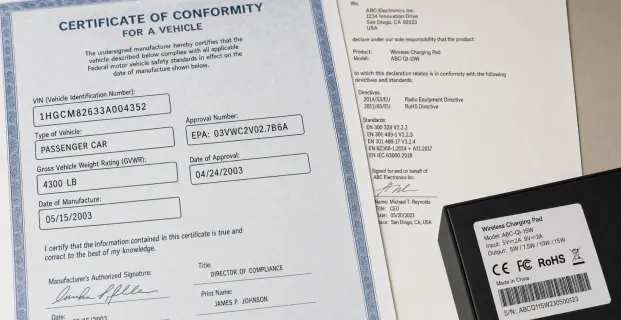
A COC certificate is an official vehicle document issued by the manufacturer or an authorized source. It confirms that a specific vehicle, identified by its VIN, conforms to the technical standards of an approved vehicle type.
In simple terms, it tells the registration authority: this car was manufactured in line with EU type-approval requirements, and here are the technical details needed to register it correctly.
A COC is most commonly used for vehicles that have EU type approval, especially passenger cars and light commercial vehicles. It is tied to one specific vehicle, not just to the model. Two cars of the same model year can have different technical specifications, so the VIN matters.
If you want a deeper explanation of the legal meaning and purpose of a Certificate of Conformity (COC), 321COC has a dedicated guide covering the concept in more detail.
What information is included on a COC?
A COC certificate is valuable because it brings together technical details that national registration offices need. The exact layout can vary by manufacturer, but it usually includes information such as:
- Vehicle Identification Number (VIN)
- Manufacturer, make, model, version, and variant
- EU type-approval number
- Engine type, fuel type, power, and displacement
- CO2 emissions and environmental category
- Vehicle mass, maximum weight, and axle loads
- Dimensions, number of seats, and body type
- Noise levels and exhaust emission data
- Tyre and wheel specifications
- Date or production-related conformity details
These details help authorities determine taxation, emissions category, registration class, and whether the vehicle meets the technical requirements for normal registration.
A COC is not a registration certificate, proof of ownership, insurance document, or roadworthiness test. It does not prove that the car is currently in good mechanical condition. Instead, it proves what the vehicle was built to be at the time it left the manufacturer.
When do you need a COC certificate?
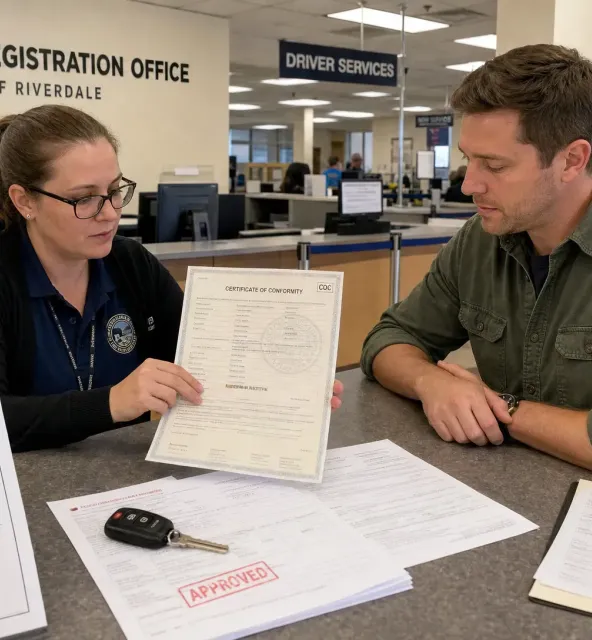
You usually need a COC certificate when a vehicle crosses a registration border. In other words, the car may be perfectly legal in one European country, but the new country still needs official technical data before it can issue local registration documents.
Importing a vehicle from another EU country
This is the most common situation. If you buy a used car in Germany and want to register it in France, Spain, Belgium, Italy, the Netherlands, or another European country, the local registration authority may ask for the COC.
The COC helps the authority transfer the vehicle into the national registration system without requiring a full individual technical approval process. It is especially useful when the foreign registration certificate does not include all the technical fields required by the new country.
Registering a used vehicle with incomplete documents
Sometimes a buyer receives the foreign registration certificate but not the original COC. In other cases, the seller may not know whether the document ever existed. If the registration office cannot find enough technical information in the documents you provide, it may request a duplicate COC or an equivalent national document.
This is common with older used vehicles, vehicles sold through auctions, or vehicles that have passed through several owners.
Exporting or selling a vehicle across borders
A COC can also make a car easier to sell internationally. If you are selling a vehicle to a buyer in another European country, providing the COC can reduce uncertainty and make the buyer more confident that registration will be possible.
It is not always legally required at the point of sale, but it can be a practical advantage. A complete document file often makes cross-border transactions smoother.
Replacing a lost original COC
Many cars are delivered with a COC when new, but owners often lose it over time. If the original is missing and you later need to import, export, or re-register the vehicle, you may need to order a duplicate.
A duplicate COC should still match the vehicle VIN and manufacturer records. Registration authorities generally care about authenticity, not whether you personally held the original document from day one.
When might you not need a COC?
A COC is important, but it is not required in every situation. If your vehicle is already registered in the same country and you are simply changing ownership locally, the national registration certificate may be enough.
You also may not be able to get a standard EU COC in certain cases, including:
- The vehicle was never EU type-approved.
- The vehicle was imported from outside Europe and built for a non-EU market.
- The vehicle is too old to have been issued an EU COC.
- The vehicle has been heavily modified from its original approved specification.
- The vehicle requires individual approval or a national conformity procedure instead.
This is why it is important to check eligibility before ordering. A genuine COC depends on manufacturer records and the vehicle's type approval status.
Why registration authorities ask for a COC
Registration authorities need more than a number plate and proof of purchase. They must classify the vehicle correctly, apply national taxes or environmental fees where relevant, and confirm that the vehicle type can be registered under local rules.
The COC gives them standardized data. Without it, the authority may need to rely on manual inspections, manufacturer confirmations, partial data from foreign documents, or national approval procedures. That can take longer and cost more.
A COC also reduces the risk of transcription errors. If a registration office enters the wrong CO2 value, weight, engine power, or variant code, it can affect taxes, insurance, and future resale paperwork. Official technical data helps prevent those issues.
How to get a COC certificate
The process is usually straightforward if the vehicle is eligible and the information you provide is accurate. Before ordering, locate the VIN on the car and compare it with the registration certificate. A single incorrect character can cause delays.
You will usually need basic vehicle information and supporting documents. Depending on the brand and country, this may include the current registration certificate, proof of identity, or proof that you are connected to the vehicle.
A typical process looks like this:
- Check whether the vehicle already has the original COC in the document folder.
- Confirm that the VIN on the vehicle matches the VIN on the registration document.
- Choose a reliable provider that can supply official EU-compliant documents.
- Submit the requested details and upload any required documents clearly.
- Review your order before payment to avoid errors.
- Keep the delivered COC safe and provide it to the registration authority when requested.
If you prefer a digital ordering process, this guide to ordering a COC online explains how online requests work and what to expect.
Common mistakes that delay a COC order
Most COC delays come from small errors that are easy to avoid. The biggest one is an incorrect VIN. The VIN has 17 characters, and confusing characters such as O and 0, or I and 1, can lead to a failed match.
Another frequent issue is uploading documents that are blurry, cropped, or incomplete. Registration certificates often have multiple pages or sections, and missing one page can prevent verification.
Vehicle modifications can also create complications. If a car has been converted, tuned, rebuilt, or significantly altered, the original COC may no longer reflect its current condition. The registration authority may then require additional checks.
For practical prevention tips, 321COC has a separate article on how to order a COC online without delays, including common document and VIN issues to avoid.
COC certificate vs other vehicle documents
A COC is often confused with other paperwork, but each document has a different purpose.
The registration certificate proves that the vehicle is registered in a specific country. It usually includes the number plate, registered owner or keeper information, and some technical data.
A roadworthiness certificate proves that the vehicle passed a periodic inspection at a specific time. It does not prove EU type approval and does not replace a COC.
A purchase invoice or sales contract proves the transaction between buyer and seller. It is important for ownership and tax purposes, but it does not contain the full technical conformity data needed for registration.
A certificate of origin is more common in customs and trade contexts. It is not the same as a Certificate of Conformity for vehicle registration.
Understanding these differences can save time. If the authority asks for a COC, sending an invoice or roadworthiness certificate will usually not solve the problem.
What to check before you import or register a vehicle
Before you buy a vehicle abroad, ask whether the COC is available. If the seller has it, check that the VIN matches the car and the registration document. If the seller does not have it, factor the cost and timing of ordering a duplicate into your purchase decision.
You should also contact the registration authority in the destination country before finalizing the import. Requirements can vary depending on the vehicle's age, origin, fuel type, emissions class, and whether it has been modified.
If you need the car registered by a specific date, do not wait until the last minute. It is better to order the COC early, especially if you must also handle insurance, taxes, technical inspection, customs formalities, or translation requirements.
Frequently Asked Questions
Is a COC certificate mandatory for every imported car? Not always. Many EU vehicle registrations require a COC, but requirements depend on the destination country, the vehicle's origin, age, and type approval status. Your registration authority can confirm what is needed.
Can I register a car without a COC? Sometimes, but the process may be longer. The authority may accept other documents, request national approval, or require additional technical inspection. For EU type-approved vehicles, a COC is often the simplest route.
Who issues a COC certificate? A COC is based on manufacturer conformity data. It may be issued by the manufacturer, an authorized channel, or a specialist provider able to obtain official EU-compliant documents for eligible vehicles.
Does a COC prove that a used car is in good condition? No. A COC confirms conformity with the approved vehicle type at production. It does not replace a roadworthiness test, mechanical inspection, or service history check.
What happens if my vehicle was made for a non-EU market? A standard EU COC may not be available. You may need a national conformity document, individual approval, or another procedure required by the country where you want to register the vehicle.
How long should I keep my COC? Keep it for as long as you own the vehicle. You may need it later for export, re-registration, resale, or administrative corrections.
Need a COC certificate for your vehicle?
If you are preparing to import, register, or sell a vehicle across borders, getting the right COC certificate early can prevent unnecessary delays. 321COC provides an online way to order official vehicle Certificates of Conformity for many brands, with secure checkout, transparent pricing, fast delivery, and money-back protection.
Start by checking your VIN and vehicle documents, then order through 321COC so you can move forward with registration confidently.