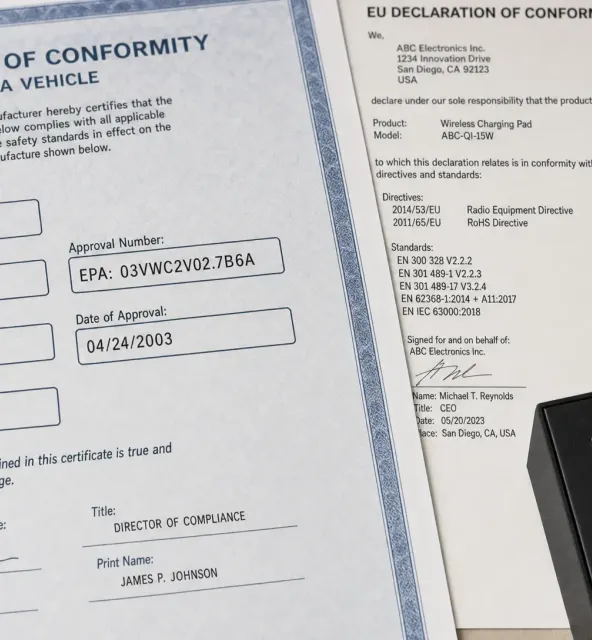
Certificate of Conformity CE Marking vs Vehicle COC
JUMP AHEAD IN THIS ARTICLE
Both terms are about compliance, but they belong to different regulatory worlds. CE marking is mainly used for certain products placed on the EU market, such as electronics, toys, machinery, personal protective equipment, and medical devices. A vehicle COC, on the other hand, is a manufacturer document used to show that a specific vehicle conforms to an approved vehicle type, which is why it matters when registering or importing a car in Europe.
That distinction is important. Ordering or presenting the wrong document can delay registration, create confusion with authorities, or lead you to pay for paperwork that does not solve your problem.
The simple difference between CE marking and a vehicle COC
Think of CE marking as a product market access system, while a vehicle COC is a vehicle registration document.
CE marking is a visible mark placed on certain regulated products. It means the manufacturer declares that the product meets applicable EU safety, health, and environmental requirements. The European Commission describes CE marking as a sign that a product has been assessed and meets EU requirements before being placed on the market.
A vehicle Certificate of Conformity, often called a COC, is different. It is a document issued for a particular vehicle, usually by the manufacturer or an authorized representative. It confirms that the vehicle matches an EU type-approved model and includes technical details that registration authorities can use.
In practical terms:
- If you are selling an electronic device in the EU, you may be dealing with CE marking and an EU Declaration of Conformity.
- If you are registering an imported car, motorcycle, van, or certain other vehicles in Europe, you are usually dealing with a vehicle COC.
- If a registration office asks for a Certificate of Conformity for a car, it usually means a vehicle COC, not a CE certificate.
The words sound similar because both use the idea of conformity. But the legal purpose, issuing party, format, and use case are not the same.
What CE marking actually means
CE marking applies to specific product categories covered by EU legislation. It is not a general quality label, and it does not mean the product was made in Europe. It means that the manufacturer has assessed the product against the applicable EU rules and takes responsibility for its compliance.
Depending on the product category and risk level, the manufacturer may be able to perform a self-assessment, or it may need a third-party assessment by a notified body. For example, some low-risk products can be CE marked based on the manufacturer’s own conformity assessment. More regulated or higher-risk products may require testing, certification, or review by a notified body.
The key document behind CE marking is usually the EU Declaration of Conformity. This is a signed statement by the manufacturer or authorized representative declaring that the product complies with the relevant EU legislation. In some cases, there may also be a certificate issued by a notified body, but that is not the same as a vehicle COC.
This is why the phrase “CE Certificate of Conformity” can be misleading. People often use it informally, but in EU product compliance, the more precise term is usually EU Declaration of Conformity, supported by technical documentation and, where required, notified body certificates.
If you want to compare the terminology more deeply in the automotive context, 321COC has a separate guide on the difference between a Declaration of Conformity and a COC.
What a vehicle Certificate of Conformity means
A vehicle Certificate of Conformity is an official document linked to a specific vehicle. It confirms that the vehicle corresponds to a type that has been approved under the applicable vehicle type-approval system.
For cars and many other road vehicles, this is not governed by CE marking rules. The EU has a separate framework for vehicle approval. Regulation (EU) 2018/858, available through EUR-Lex, sets out the approval and market surveillance framework for motor vehicles and their trailers, and for systems, components, and separate technical units intended for such vehicles.
A vehicle COC typically includes information such as:
- Vehicle identification number, or VIN
- Manufacturer and vehicle type details
- EU type-approval number
- Variant and version
- Engine and fuel information
- Emissions data
- Masses and dimensions
- Noise levels
- Tire and axle information
Registration authorities use this data to check whether the vehicle can be registered without requiring a full individual technical approval. The COC helps prove that the vehicle was built according to an approved specification.
If you want to see how these fields are usually structured, this explanation of the Certificate of Conformity format walks through the main sections found on a vehicle COC.
Why people confuse CE marking and vehicle COC
The confusion is understandable because both systems use similar words. “Certificate of Conformity” is a broad phrase that can appear in different industries. It might refer to a manufacturer statement, a test laboratory certificate, a notified body certificate, a customs document, or a vehicle COC.
The problem is that the phrase changes meaning depending on the context.
In CE marking, conformity means a regulated product meets applicable EU product safety rules. The product may display the CE mark, and the manufacturer keeps technical documentation and signs an EU Declaration of Conformity.
In vehicle registration, conformity means a specific vehicle conforms to an approved type. The relevant document is the vehicle COC, which is tied to the VIN and used by registration authorities.
So if someone asks, “Do I need a Certificate of Conformity?” the next question should be, “For what purpose?”
If the purpose is placing a product on the EU market, you may be in CE marking territory. If the purpose is registering a car imported from another European country, you are almost certainly in vehicle COC territory.
Does a car need CE marking?
In general, complete passenger cars do not use CE marking as their primary conformity system. They are regulated through vehicle type approval, not ordinary CE marking legislation.
This does not mean that nothing related to a car can ever fall under CE rules. Certain accessories, tools, chargers, diagnostic devices, garage equipment, or aftermarket electronic products may fall under CE marking legislation if they are placed on the EU market as separate products. Some vehicle components may also be subject to other approval marks and automotive-specific rules.
But for registering the vehicle itself, the relevant proof is normally the vehicle COC, national approval documentation, or another form of vehicle conformity evidence accepted by the registration authority.
A CE mark on a product related to a vehicle does not replace a COC for the vehicle. For example, a CE-marked battery charger, roof box accessory, or workshop tool does not prove that the car itself conforms to an EU type-approved vehicle specification.

Which document do you need for EU vehicle registration?
For vehicle registration, especially when importing a car from one European country to another, the document commonly requested is a vehicle Certificate of Conformity.
A COC is often used when a vehicle was originally manufactured for the European market and has an EU type approval. It helps the registration authority confirm technical specifications without asking you to provide every detail separately.
Typical situations where a vehicle COC may be needed include:
- Registering an imported used car in another EU country
- Registering a new vehicle bought abroad
- Re-registering a vehicle after moving residence
- Proving technical data such as CO2 emissions, engine power, or weight
- Completing local registration paperwork where the authority requires conformity proof
However, not every vehicle has an available COC. Some older vehicles, non-EU market vehicles, modified vehicles, or vehicles without EU type approval may require a different process. That can include national approval, individual vehicle approval, or other documents depending on the country.
For a broader registration-focused explanation, see this guide to using a COC Certificate of Compliance for EU registration.
How to avoid ordering the wrong conformity document
Before ordering any conformity paperwork, identify the exact reason you need it. This is the easiest way to avoid confusing CE documentation with a vehicle COC.
Ask yourself these questions:
- Are you trying to register a vehicle, or are you placing a product on the EU market?
- Is the document being requested by a vehicle registration office, customs office, buyer, marketplace, importer, or product safety authority?
- Does the request mention a VIN, type approval number, CO2 emissions, or vehicle technical specifications?
- Does the request mention CE marking, directives, harmonized standards, notified bodies, or an EU Declaration of Conformity?
- Is the document supposed to be issued for one specific car, or for a batch or model of products?
If the request includes a VIN and is linked to car registration, you likely need a vehicle COC. If the request relates to a product being sold in the EU and mentions CE directives or harmonized standards, you are likely dealing with CE conformity documentation.
When in doubt, ask the authority or organization requesting the document to confirm the exact wording. In many registration cases, the local office may simply say “certificate of conformity,” but what they mean is the vehicle COC.
Example scenarios
A driver buys a used car in Germany and wants to register it in France. The registration authority asks for a Certificate of Conformity. In this situation, the driver normally needs a vehicle COC, not a CE certificate.
A company imports a new electrical appliance from outside the EU and wants to sell it online in Europe. The company must check whether the product falls under CE marking legislation, prepare the required technical documentation, and make sure the correct conformity assessment process has been followed. That is a CE marking issue, not a vehicle COC issue.
A person buys an imported car from outside Europe with no EU type approval. A standard European COC may not be available. The person may need to follow a national or individual approval process depending on the destination country.
A workshop sells a standalone diagnostic tool for cars. The tool itself may need CE marking if it falls within CE legislation, but that has no effect on whether a customer’s vehicle needs a COC for registration.
These examples show why the purpose matters more than the wording. “Conformity” is a broad concept, but the correct document depends on the object being assessed and the authority asking for proof.
Key takeaway
Certificate of conformity CE marking and a vehicle COC are not interchangeable.
CE marking is about regulated products being placed on the EU market. It is usually supported by an EU Declaration of Conformity and technical documentation. A vehicle COC is about a specific vehicle conforming to an approved vehicle type. It is used mainly for registration, import, and administrative checks.
If you are registering a car in Europe, focus on the vehicle COC. If you are selling a product in the EU, focus on CE marking rules. Mixing the two can cost time, money, and unnecessary paperwork.
Frequently Asked Questions
Is a CE Certificate of Conformity the same as a vehicle COC? No. A CE conformity document relates to product compliance under CE marking rules. A vehicle COC relates to a specific vehicle and is used to prove conformity with vehicle type approval for registration purposes.
Do cars have CE marking in the EU? Complete passenger cars are generally regulated through vehicle type approval, not CE marking. Some separate vehicle accessories or equipment may need CE marking, but that does not replace a vehicle COC.
What document do I need to register an imported car in Europe? In many cases, you need a vehicle Certificate of Conformity. The exact requirements depend on the country, vehicle age, origin, and approval status.
Is an EU Declaration of Conformity enough to register a car? Usually no. A Declaration of Conformity is most commonly associated with CE-marked products. Vehicle registration authorities usually require a vehicle COC or another accepted vehicle conformity document.
Can I use a CE certificate instead of a COC? For car registration, generally no. A CE certificate does not contain the vehicle-specific type approval and technical data that registration authorities usually need.
Need an official vehicle COC?
If your goal is to register an imported or transferred vehicle, make sure you request the correct document. 321COC helps vehicle owners order official Certificates of Conformity online for many car brands across Europe, with a secure process and transparent pricing.
You can start your request through 321COC and avoid confusing a vehicle COC with CE marking paperwork.