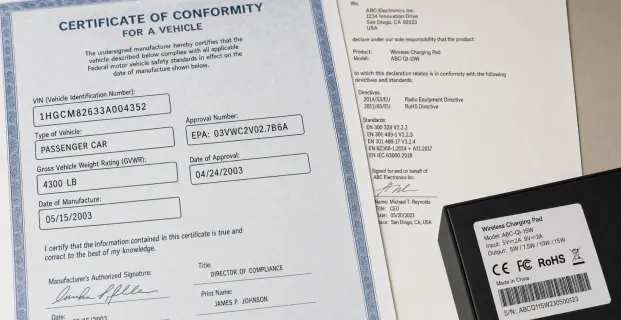
Cert of Conformity for Imported Cars Explained
JUMP AHEAD IN THIS ARTICLE
Importing a car can be a smart way to access a better price, a specific trim, or a vehicle that is easier to find in another European market. The part that often slows people down is not the drive home. It is the paperwork.
A cert of conformity, more formally called a Certificate of Conformity or COC, is one of the key documents registration offices use to confirm that an imported vehicle matches an approved European type. If the document is missing, incomplete, or not accepted in the destination country, registration can become slower, more expensive, and more stressful.
This guide explains what the cert of conformity does for imported cars, when you are likely to need one, what information it contains, and how to prepare your registration file with fewer surprises.
What is a cert of conformity for an imported car?
A cert of conformity is an official document linked to a specific vehicle. It confirms that the car was manufactured according to an approved type and meets the relevant technical and environmental requirements stated by the manufacturer for that model.
For imported cars, the COC acts as a bridge between the country where the vehicle was first sold and the country where you want to register it now. Instead of asking the registration authority to manually verify every technical detail, the COC provides a standardized set of data, usually tied to the vehicle identification number, also called the VIN.
A COC is not the same as the registration certificate from the country of origin. It is also not the same as an invoice, an insurance policy, or a technical inspection report. Those documents may all be part of your import file, but the COC answers a different question: does this exact vehicle correspond to an approved type with defined specifications?
If you want a broader definition before focusing on imports, this car owner’s guide to the Certificate of Conformity explains the basics in more detail.
Why imported cars often need a COC
When a car is sold and registered in its original market, the local authority already has access to the information it needs. When that same car crosses a border, the new authority may not have the same data in its national system.
The cert of conformity helps fill that gap. It can support several parts of the registration process, including vehicle identification, emissions classification, tax calculation, roadworthiness checks, and confirmation that the car was built for EU-compliant use.
This matters especially when the vehicle is imported from one European country to another. Even within the EU, national registration systems are not identical. One country may ask for specific emissions fields, while another may focus on the EU type approval number, weights, or noise values.
A valid COC can make the process smoother because it gives officials a recognized source for the vehicle’s technical data. Without it, you may be asked to provide alternative evidence, complete a national approval procedure, or attend additional inspections.
When a cert of conformity is usually required
A cert of conformity is commonly requested when a passenger car is imported and registered in a different European country from the one where it was previously registered or sold. It is particularly relevant when the vehicle has an EU type approval and has not been heavily modified.
You are more likely to need a COC if:
- You bought a used car in another EU country and want to register it locally.
- You are moving countries and bringing your own car with you.
- The registration office needs technical data that is missing from the foreign registration certificate.
- The vehicle’s emissions or weight information is required to calculate taxes or fees.
- The car was originally manufactured for the European market and has an EU type approval.
However, a COC is not a universal solution for every vehicle. Older vehicles, non-EU market vehicles, individually imported models, heavily modified cars, or vehicles without European type approval may require a different route. In those cases, the authority may ask for a national approval, single vehicle approval, technical inspection, or manufacturer statement.
Because rules vary by country and sometimes by vehicle category, it is worth checking the destination country’s requirements before you buy the car or start the import process. If your main question is whether the document is required in your situation, this guide on whether you need a COC to register an imported car is a useful next step.
What information does the COC include?
A cert of conformity contains the technical identity of the vehicle. The exact layout can vary by manufacturer and document type, but the core purpose is always the same: to provide official data that links the car to its approved specification.
Typical information on a COC includes:
- Manufacturer name and vehicle category.
- VIN and commercial model name.
- EU type approval number, when applicable.
- Engine type, fuel type, power, and displacement.
- CO2 emissions and environmental classification data.
- Vehicle mass, maximum permitted weight, and axle loads.
- Dimensions, seating capacity, and number of doors.
- Tire and wheel specifications.
- Noise level and sometimes additional technical values.
- Date or version details connected to the approved type.
These fields matter because registration offices use them to create the national registration record. If a value is missing or inconsistent with the car, it can trigger questions or delays.
For example, if the VIN on the COC does not match the vehicle or the sales paperwork, the authority will not treat the file as clean. If the emissions data is missing, the tax office may not be able to calculate the correct amount. If the type approval number is absent for a vehicle that should have one, the office may ask for further evidence.
If you want to understand how the document is typically structured, this explanation of the conformity certificate format for imported cars breaks down the main sections.
How the cert of conformity fits into the import file
The COC is important, but it is only one part of the import paperwork. Registration authorities usually look at the file as a whole. They want to know who owns the vehicle, where it came from, whether taxes or customs obligations apply, and whether it meets local road rules.
A typical imported car file may include the foreign registration certificate, proof of purchase, proof of identity, proof of address, insurance confirmation, technical inspection documents, customs or VAT paperwork when relevant, and the cert of conformity.
If you are relocating, keep vehicle paperwork separate from personal belongings paperwork. For example, a receipt for personal items such as minimalist stainless steel jewelry may be useful for your own moving records, but it will not help prove vehicle conformity. The registration office needs documents that identify the car, its ownership, its tax status, and its technical approval.

How to get a cert of conformity for an imported car
The best time to think about the COC is before you complete the purchase. A seller may already have the original document, especially for newer vehicles. If not, you may need to order one using the car’s VIN and supporting details.
In most cases, you will need accurate vehicle information before requesting the document. The VIN is essential because the COC is tied to a specific vehicle, not just to a model or brand. You may also need the current registration document, proof of ownership, and personal contact details depending on the provider or manufacturer process.
A simple approach is to follow these steps:
- Check whether the destination authority asks for a COC: Requirements differ by country, so confirm what is needed before you book inspections or appointments.
- Verify that the vehicle is eligible: Cars built for the EU market with an EU type approval are usually the most straightforward cases.
- Collect the VIN and registration details: Make sure the VIN on the car, sales documents, and foreign registration certificate all match.
- Order the official document from a trusted source: Use a provider that supplies recognized documents and explains pricing clearly.
- Review the COC before submission: Check the VIN, model, fuel type, emissions values, and approval details for obvious inconsistencies.
321COC provides a secure way to order official vehicle Certificates of Conformity online for many car brands across Europe. The service focuses on EU-compliant documents, transparent pricing, fast delivery, and money-back protection, which can be especially useful when you are working against registration deadlines.
Common mistakes that delay imported car registration
Many registration delays happen because the COC is treated as a last-minute formality. In reality, one missing or incorrect document can affect the entire import timeline.
One common mistake is assuming the foreign registration certificate contains everything the new authority needs. It may include key data, but it often does not include the full technical information found on a COC.
Another mistake is ordering the wrong document. A generic workshop certificate, a roadworthiness test, or a translation of the foreign registration certificate is not the same as an official Certificate of Conformity. If the authority specifically asks for a COC, submitting another document may not solve the issue.
Buyers also sometimes forget to check whether the car has been modified. Changes to suspension, engine mapping, exhaust systems, wheels, lighting, or seating can create a mismatch between the car and the original conformity data. Even if the COC is valid for the original vehicle, the registration office may ask for proof that the current vehicle condition is still compliant.
Finally, spelling and number errors can cause unnecessary problems. A single incorrect character in the VIN can make a document unusable for registration. Always compare the VIN on the vehicle, not only on the seller’s advertisement.
Official COC vs alternative approval routes
For many imported European cars, the COC is the cleanest route because it confirms that the car corresponds to an existing approved type. But not every vehicle will qualify.
If a car was built for a market outside Europe, it may not have an EU Certificate of Conformity. This does not automatically mean it cannot be registered, but the path may be different. You may need a national individual approval, additional testing, technical modifications, or a certificate issued under local rules.
Classic cars can also be different. Depending on the age, country, and vehicle history, the registration office may use historic vehicle procedures, archive records, or national technical inspections instead of a standard COC.
This is why it is important to understand the vehicle’s origin before buying. A car that looks identical to a European model may have different lighting, emissions equipment, speedometer markings, or approval data if it was manufactured for another market.
Practical checklist before you submit your file
Before your registration appointment, take a few minutes to review the whole file. This simple check can prevent repeat visits and unexpected requests.
Make sure the VIN is consistent across the car, invoice, foreign registration certificate, and COC. Confirm that the seller’s name and buyer’s name are clear in the proof of purchase. Check whether you need an official translation of any foreign documents. Verify whether the destination country requires a recent roadworthiness inspection. If customs or VAT documents apply, keep them in the same file but clearly separated from the technical documents.
The goal is to make the registration officer’s job easy. A complete, consistent, and well-organized file gives them fewer reasons to pause the process.
Frequently Asked Questions
Is a cert of conformity the same as a COC? Yes. “Cert of conformity” is an informal way to refer to a Certificate of Conformity, commonly abbreviated as COC. For vehicle imports, the official document confirms technical conformity for a specific vehicle.
Can I register an imported car without a cert of conformity? Sometimes, but it depends on the country, vehicle age, origin, and approval status. If no COC is available, the authority may ask for national approval, an inspection, or alternative manufacturer documentation.
Do used imported cars need a Certificate of Conformity? Many used imported cars need a COC, especially when moving between European countries. The document helps the new authority confirm technical data that may not appear on the foreign registration certificate.
Does a COC expire? A COC generally describes the vehicle as manufactured and does not expire like an insurance policy. However, modifications, missing documents, or country-specific registration rules can still affect whether it is accepted.
Is a scanned copy enough for registration? Some offices may accept digital copies for pre-checks, but many authorities still ask for an original or officially issued document. Always confirm the requirement before your appointment.
Make your imported car registration easier
A cert of conformity is not just another piece of paperwork. For many imported cars, it is the document that helps the registration authority identify the vehicle correctly, verify its approved specifications, and process the file with fewer delays.
If you need an official Certificate of Conformity for an imported vehicle, 321COC offers an online ordering process for many brands, with secure checkout, transparent pricing, and EU-compliant documents. Preparing the right COC early can save time, reduce uncertainty, and make your registration process far more predictable.