Certificate of Conformity Explained for Car Owners
JUMP AHEAD IN THIS ARTICLE
Do I Need a COC to Register an Imported Car?
If you have just bought a car in another European country — or you are about to — the practical question is simple: will the registration office ask for a Certificate of Conformity, and what happens if you do not have one?
The short answer: for most EU-market cars imported between European countries, yes, the authority will very likely want the COC, because it is the one document that carries the vehicle's full approved technical data. For vehicles without EU type approval, older cars, or heavily modified ones, the answer changes — and there are alternative routes.
This guide walks through when the COC is needed, when it is not, how to prepare the request so it does not delay your appointment, and how the document helps even when you are the seller.
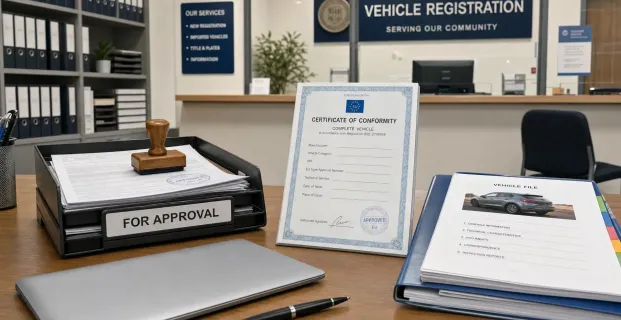
What the COC does at the registration desk
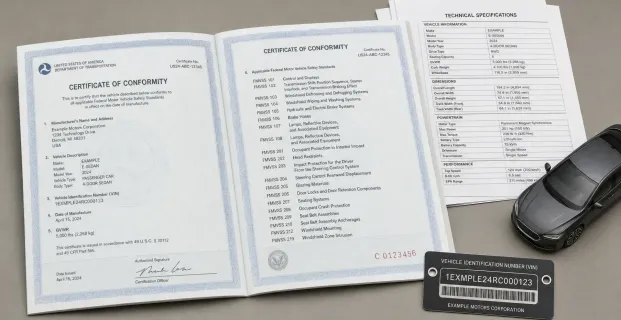
A Certificate of Conformity is the vehicle's technical identity document: it links one specific VIN to an EU type-approved specification, listing the data a registration office needs — emissions, masses, dimensions, engine details, tire sizes, type approval number. If you want the full technical definition, see our guide on what a Certificate of Conformity is. Here we stay practical.
When your car crosses a border, the new country's authority has to translate it into its own administrative system. A foreign registration certificate rarely contains everything they need, and it is often in a language the clerk cannot process directly. The COC closes that gap in one standardized document.
Two quick examples of how this plays out:
Škoda Octavia bought in Austria, registered in Slovakia. The Austrian Zulassungsschein shows basic data, but the Slovak office needs the CO2 value and type approval number to classify the vehicle correctly. With the COC in the file, the technical part of the registration is a formality. Without it, the owner is sent to obtain technical documentation first — and the temporary plates keep ticking.
Volkswagen Golf sold from Germany to a buyer in the Netherlands. The Dutch RDW inspection goes faster when the approved specification is on the table; the buyer does not have to chase the German dealer for paperwork after the car has already left the country.
When you need a COC — and when you don't
You will most likely need the COC when:
- You import a used car from another EU or European country and apply for local plates.
- You move abroad and re-register your own car in the new country.
- The registration office asks for official technical data — emissions, weights, type approval — that your foreign papers don't show.
- You are selling a car to a buyer abroad and want the sale to survive their registration process.
You may not need one — or one may not exist — when:
- The vehicle was built for a non-European market (US, Japan, Swiss-only versions). An EU COC usually cannot be issued; the route is national individual approval instead.
- The car predates EU-wide type approval for its category. Older and classic vehicles often follow a national procedure with a data sheet or inspection report.
- The vehicle has been substantially modified — engine, emissions equipment, seating, body structure. The original COC then describes a car that no longer exists in that form, and the authority will want inspection reports on top.
The registration decision always belongs to the authority in the country where you register. A COC removes the technical questions; it does not replace ownership proof, insurance, customs documents, or a roadworthiness inspection where national rules require one.
Prepare the request before your appointment, not after
Most COC delays are self-inflicted, and almost all of them start with the VIN.
Check the 17-character VIN in at least two places — the registration certificate and the car itself (windshield base, driver-side door frame, or chassis stamping) — and copy it character by character. O and 0, I and 1 look alike; one wrong character matches the wrong vehicle or nothing at all.
Then gather: the current or previous registration certificate (all pages, readable scans), proof of purchase, make, model, and first registration date. If the car has been modified, say so upfront — it is better to learn about a problem before paying than after.
Timing matters more than owners expect. Order the COC as soon as you know the car is coming, not the week of your registration appointment. Delivery times differ by brand — some manufacturers issue within days, others take two weeks or more — and 321COC shows the expected delivery time next to the price for each brand before you order, so you can plan the appointment around a realistic date instead of hoping.
The mistakes that actually cost time
Three patterns come up again and again:
Assuming the foreign registration certificate is enough. It summarizes; the COC specifies. Authorities that need manufacturer-level data will send you back for it.
Treating the COC as a universal pass. It is not proof of ownership, not an inspection certificate, not a customs document. Countries can still require technical inspection, tax clearance, or translated documents — check the full list for your country before booking anything.
Waiting until the temporary plates are about to expire. A document that would have been routine three weeks earlier becomes an emergency. Emergencies are where owners get tempted by generic PDF "certificates" from unverifiable sources — which registration offices reject, and which a serious provider will never sell you.
Selling abroad? The COC is your closing argument
If your buyer needs to register the car in another country, a ready COC removes their biggest source of hesitation. It shows the technical file is complete and the specifications can be verified against an official source — which matters most in private sales, where paperwork doubt kills deals.
You should never promise the buyer that registration will be approved; that is the authority's call. But handing over a complete file — registration documents, service history, proof of ownership, COC — is the difference between a buyer who negotiates the price down "because of the paperwork risk" and one who doesn't.
FAQ
Is a COC mandatory for registering an imported car? In most EU countries the authority will request it for an EU type-approved vehicle imported from another member state. For vehicles that cannot obtain one, national approval procedures exist instead.
Can I register a car without a COC? Sometimes — through a national individual approval, technical data sheet, or inspection route. It is usually slower and more expensive than obtaining the COC where one is available.
Who issues the COC? The manufacturer, or an authorized route working from manufacturer type approval data. The document must match the vehicle's exact VIN.
How long does it take to get a COC? It depends on the brand — from a couple of days to two weeks or more. 321COC lists the delivery time per brand next to the price, so check before you book your registration appointment.
Can I use a COC issued in another country? Yes — the EC Certificate of Conformity is designed to be recognized across EU registration systems. What the local office accepts alongside it is decided nationally.
Get the COC before the appointment, not because of it
If your car is imported, being imported, or about to be sold abroad, the COC is the document that keeps the technical side of registration boring — which is exactly what you want it to be.
321COC provides official EU-compliant Certificates of Conformity for a wide range of brands, with the price and delivery time visible per brand before checkout, secure ordering by VIN, fast delivery, and money-back protection where applicable. Check the VIN, prepare your documents, and order early — the rest of the file will thank you.