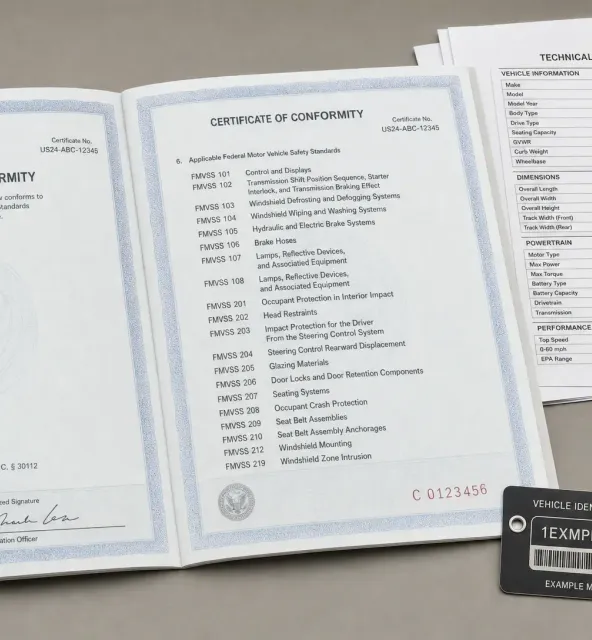
Conformity Certificate Format for Imported Cars
JUMP AHEAD IN THIS ARTICLE
When you import a car, the Certificate of Conformity often becomes the document that turns technical specifications into registration approval. Yet many owners search for the conformity certificate format because they are not sure what a valid COC should look like, which fields matter, or how registration authorities use it.
The short answer is that a car COC is not just a generic certificate with a stamp. It follows a structured format based on EU vehicle type-approval rules, but the visual layout can vary by manufacturer, model year, vehicle category, and issuing country. Knowing the expected structure helps you spot missing information, avoid delays, and submit a stronger registration file for an imported car.
What the conformity certificate format actually covers
A vehicle Certificate of Conformity is issued by the manufacturer or an authorized representative to confirm that a specific vehicle, identified by its VIN, conforms to an approved type. For passenger cars imported into Europe, it usually supports national registration by proving that the vehicle meets the applicable EU technical and environmental requirements.
If you need a broader introduction before focusing on the document layout, 321COC also explains what a Certificate of Conformity is and why car owners need it.
The format is shaped by EU type-approval legislation, including Regulation (EU) 2018/858, which governs approval and market surveillance for motor vehicles and their trailers. Detailed administrative models and certificate templates are further addressed in Commission Implementing Regulation (EU) 2020/683. In practical terms, this means a COC is expected to contain a harmonized set of technical fields, not merely a statement that the car is compliant.
It is also important to separate the COC from other documents. It is not a registration certificate, not a sales invoice, not a roadworthiness test, and not proof that taxes or customs duties have been paid. It is a technical conformity document tied to the vehicle itself.
Why the format matters for imported cars
When a car is imported, the registration authority needs to understand what it is, how it was approved, and whether its technical characteristics can be entered into the national registration system. The conformity certificate format makes that possible because it presents key data in a standardized way.
A registration office may use the COC to confirm the EU type approval, the vehicle category, emissions information, mass limits, engine power, fuel type, noise values, tire specifications, and other registration-relevant details. These details can influence administrative approval, technical inspection requirements, vehicle tax, environmental classification, or access to low-emission zones depending on the country.
A COC in the wrong format, a partial copy, or a document missing essential data may create delays. In some cases, the authority may ask for a corrected COC, a manufacturer confirmation, a translation, or a separate individual approval process. If your main question is whether the document is required for your case, this guide on needing a COC to register an imported car explains the typical situations in more detail.
Core sections you should expect on a car COC
Although different brands may design their certificates differently, the underlying content is usually organized around the same categories. The certificate may be one page or several pages, but the data should be specific, structured, and consistent with the vehicle.
Header and issuer information
The first part usually identifies the certificate as a Certificate of Conformity and names the manufacturer, authorized representative, or type-approval holder. It may also include the manufacturer address, vehicle category, certificate reference, or legal statement confirming that the vehicle conforms to an approved type.
This header matters because a valid COC is not created by the seller, an importer, or a private template provider. It should come from the manufacturer or an authorized source linked to the vehicle brand.
Vehicle identification details
The most important identifier is the VIN, the Vehicle Identification Number. It must match the VIN stamped on the vehicle, shown on the manufacturer plate, and listed on the purchase or export documents. Even one wrong character can block or delay registration.
This section commonly includes the make, commercial name, type, variant, version, vehicle category, and sometimes bodywork information. The type, variant, and version codes are especially useful because they connect the individual car to an approved technical configuration.
Type-approval information
A valid EU COC normally contains an EC or EU type-approval number. The approval number may include references to the legal framework in force when the vehicle was approved, such as older Directive 2007/46/EC references for older vehicles or newer Regulation 2018/858 references for more recent approvals.
Do not panic if an older vehicle does not show the newest regulation number. The key question is whether the document matches the vehicle and refers to a valid approval framework for that vehicle at the time.
Masses, dimensions, and axle data
The COC format usually includes technical dimensions such as length, width, height, wheelbase, track width, and axle details. It may also list mass in running order, technically permissible maximum laden mass, axle loads, towing limits, and trailer-related values.
These fields are not just engineering trivia. Registration databases often need them to define the vehicle correctly, and inspection authorities may compare them against the physical vehicle when there is uncertainty.
Engine, fuel, emissions, and environmental data
For petrol and diesel vehicles, the COC usually states engine capacity, maximum net power, fuel type, emissions standard, CO2 emissions, and other environmental values. For hybrid and electric vehicles, the relevant propulsion and energy data may replace or complement combustion-engine fields.
This section is one reason registration offices often request the original COC for imported cars. Emissions values can affect taxes, environmental labels, and registration eligibility in certain jurisdictions.
Tires, noise, braking, and other technical fields
A COC may list approved tire and wheel combinations, noise levels, braking system references, seating capacity, number of doors, color, and other technical elements. The exact depth depends on the vehicle type, approval framework, and manufacturer format.
Do not assume these fields are optional simply because they look less important than the VIN or emissions data. If a national system requires a specific field and it is missing, the application may be returned for clarification.
Declaration, date, and signature
Near the end of the document, you should find a conformity declaration confirming that the vehicle described by the VIN conforms to the approved type. The certificate usually includes an issue date and the identity or signature of the authorized person or issuing entity.
Some manufacturers use security features, stamps, special paper, QR codes, or digital validation methods. These features vary, so the absence of one specific visual element does not automatically mean the document is fake. Still, the certificate should clearly look like an official manufacturer-issued document, not an editable form.
Official COC vs lookalike certificate
Because imported car paperwork can be stressful, many owners are tempted by fast, cheap, unofficial templates. The risk is that a document may look professional but still be useless for registration.
Watch for these red flags before submitting a certificate:
- The VIN is missing, incomplete, or different from the vehicle.
- The type-approval number is absent where one should be expected.
- The document looks like a generic editable template rather than a manufacturer-issued certificate.
- Key fields such as emissions, mass, vehicle category, or technical type are blank.
- The certificate is issued by a party that is not the manufacturer or an authorized representative.
- The data conflicts with the vehicle, invoice, export papers, or registration history.
A valid COC is vehicle-specific. It cannot be reused from a similar car, even if the make, model, engine, and year appear identical. The VIN is what links the certificate to the individual vehicle.
How registration authorities read the COC format
Registration authorities usually do not read a COC like a consumer brochure. They use it as a technical data source. The official reviews the VIN first, then checks approval information, vehicle category, technical specifications, and fields needed for the local registration database.
For example, the registration system may need the vehicle category, number of seats, fuel type, CO2 emissions, noise level, engine power, mass, and tire dimensions. If the car is imported from another European country, these fields help the authority transfer the vehicle into the national system without requiring a full technical re-approval.
Still, the COC is only one part of the import file. You may also need proof of ownership, previous registration documents, customs or tax documents, insurance, and a roadworthiness inspection depending on the country. For the full administrative sequence, see 321COC's guide to registering an imported vehicle in Europe.
Frequently Asked Questions
Is there one official conformity certificate format for all cars? No. The required content is standardized by EU type-approval rules, but the visual layout can vary by manufacturer, vehicle age, language, and document generation system. A valid COC may look different from another brand's COC.
Is a scanned COC enough to register an imported car? It depends on the country and the authority. Some procedures may allow digital submission, while others require the original or a certified version. Always check local registration rules before relying on a scan.
What if my imported car has no COC? If the car was not built for the EU market or does not have EU type approval, a standard EU COC may not be available. You may need individual approval, a technical inspection, or another national compliance route.
Does the COC need to be translated? Often, the standardized field structure helps authorities interpret the document, especially within Europe. However, some local offices may still request a translation or additional confirmation, so it is best to verify requirements before your appointment.
Is a COC the same as a registration certificate? No. A registration certificate proves that a vehicle is registered in a country. A COC confirms that a specific vehicle conforms to an approved technical type and provides data used for registration.
Need a COC in the correct format for your imported car?
If your registration authority asks for a Certificate of Conformity, make sure the document is official, vehicle-specific, and suitable for your import file. 321COC helps car owners order official EU-compliant vehicle certificates online for many brands, with transparent pricing, secure checkout, fast delivery, and money-back protection.
You can start your request through 321COC and prepare your imported car registration with more confidence.