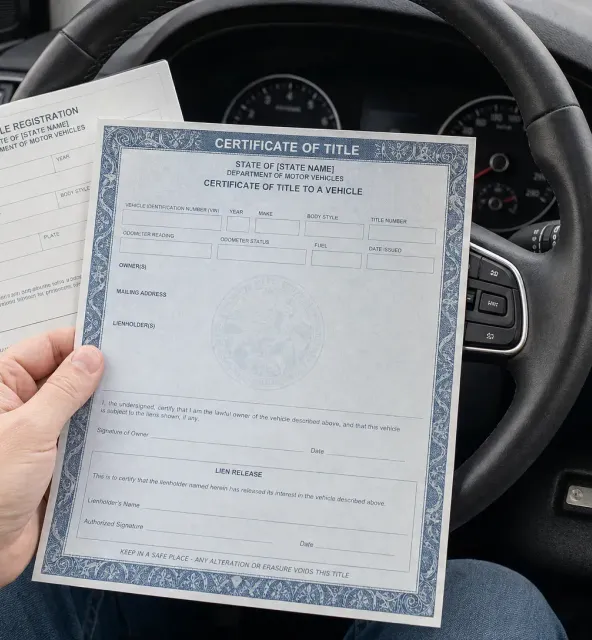
Certificate of Conformity Example: What a COC Actually Looks Like
JUMP AHEAD IN THIS ARTICLE
If you are importing, registering, or re-registering a vehicle in Europe, the phrase Certificate of Conformity can sound abstract until you see what the document actually contains. A certificate of conformity example helps you understand why registration offices ask for it: the COC links one specific vehicle, identified by its VIN, to an EU type-approved specification.
Below is a realistic, fictional EU vehicle COC example, followed by a plain-English explanation of the fields that matter most. Use it as a reading guide, not as a template - a real COC must be issued by the manufacturer or an authorized official source. For a broader overview of the document, see our guide to what a COC certificate is and when you need one.
Fictional Certificate of Conformity example
The example is simplified and fictional. Real documents vary by manufacturer, model year, category and country; many are printed on secure paper across several pages.
European Community Certificate of Conformity Passenger vehicle, category M1
Manufacturer: Example Motors S.A. Make: Example Motors Commercial name: Example Compact 1.5 Hybrid Type: EXC · Variant: H15 · Version: A2 Vehicle identification number: WEX12345678900001 EU type-approval number: e1*2018/858*00123*02 Date of issue: 09/07/2026
Number of axles: 2 · Seats including driver: 5 Mass in running order: 1,420 kg Technically permissible maximum laden mass: 1,910 kg Wheelbase: 2,680 mm · Tyres: 205/55 R17
Engine: petrol hybrid, 1,498 cm³, 110 kW · Maximum speed: 205 km/h
CO₂ emissions: 119 g/km · Combined consumption: 5.2 l/100 km Emission standard: Euro 6d · Sound level stationary: 72 dB(A)
Declaration: The vehicle described above conforms in all respects to the approved type stated in this certificate. Authorized signature and manufacturer stamp
Some real COCs add sections for braking, towing weights, axle loads, gear ratios, bodywork, electric range or WLTP values - the structure stays the same.
How to read it: five areas
1. Vehicle identity. The VIN is the critical field - it must match the vehicle and any existing registration document character for character. Type, variant and version pin down the exact configuration: two cars with the same model name can differ in engine, emissions or axle loads.
2. EU type-approval number. The proof that the vehicle belongs to an approved type. The structure encodes the granting country (e1 = Germany, e2 = France…), the regulation (2018/858 for newer vehicles, 2007/46/EC for older ones), the base approval and extension. You don't need to decode every digit - it needs to be present, legible and consistent with the vehicle.
3. Technical specifications. Masses, seats, wheelbase, tyres, engine capacity and power - the values national registers record, which can affect road tax, insurance class and towing permissions.
4. Emissions and fuel data. Often the section with the most real-world impact: CO₂ and the Euro standard can determine registration tax, annual tax and low-emission zone access. Authorities rely on the official COC values rather than estimates.
5. Manufacturer declaration. The signed statement that this individual vehicle conforms to the approved type - usually with signature, stamp or security features. This is what separates a valid COC from a brochure, dealer printout or VIN-decoder sheet showing similar data.
For the full field-by-field breakdown, differences between brands and the red flags of unofficial documents, see our guide to the Certificate of Conformity format.
What a COC example cannot prove
An example helps you understand the structure - only a real COC issued for your VIN supports a registration application. It also does not prove ownership (that's the invoice or sales contract) and it is not a roadworthiness certificate: a vehicle with a valid COC may still need a technical inspection depending on age and destination country. And if a vehicle was built for a non-EU market, a standard EU COC may not be available at all - the route is then individual approval or a national procedure.
Frequently asked questions
What does a Certificate of Conformity look like? An official manufacturer document with vehicle identity, EU type-approval data, technical specifications, emissions values and a signed conformity declaration. The layout varies by brand.
Can I use a certificate of conformity example for registration? No - an example is a reading aid. Registration requires an official COC issued for your exact VIN.
Is a COC the same as a registration certificate? No. The registration certificate proves the vehicle is registered in a country; the COC proves conformity with an approved type.
Why do the emissions values matter? They can drive registration tax, annual tax and low-emission zone access - which is why authorities want the official values.
Need an official COC for your vehicle?
Don't recreate a COC from an example - authorities need the official document. With 321COC you can order an official EU-compliant Certificate of Conformity online for many car brands, with transparent pricing, secure checkout, fast delivery and money-back protection. Start with your VIN - checked against the vehicle itself, not just the sales listing.
Currently available COC online on 321COC: