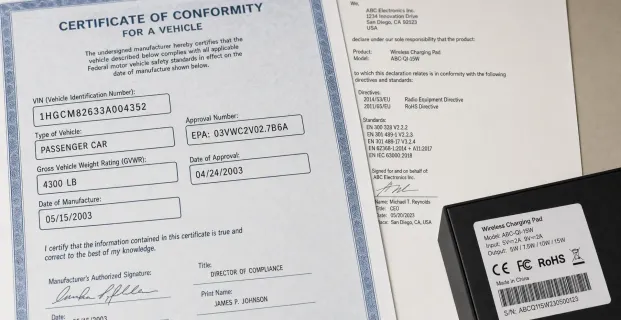
Certificate of Conformity UK: Rules After Brexit
JUMP AHEAD IN THIS ARTICLE
What Brexit changed for the Certificate of Conformity
Before Brexit, an EU Certificate of Conformity was accepted across the UK because Britain was part of the EU type-approval system. That mutual recognition ended, and Great Britain built a separate framework:
- GB type-approval scheme — from February 2026, M and N category vehicle types must hold a full GB or UKNI type approval (g11 / n11) to be manufactured for sale in Great Britain.
- End of the EU-COC option — during a transition, manufacturers could still supply an EU COC with GB vehicles. That option ran until 6 July 2026; after it, GB-market vehicles move to GB certificates of conformity, each carrying a unique GB approval number. Electronic certificates (eCOC) are being introduced alongside paper ones see how the UK eCOC system works.
In short: new GB-market cars now use GB COCs, while EU COCs remain the reference document for vehicles approved in the EU — including the used cars people import.
Does an EU Certificate of Conformity still work for UK registration?
For most people the practical question is: I'm bringing a car in from Germany, France, Spain or elsewhere in the EU — do I still need an EU COC? In practice, yes, it's still highly useful. When you register an imported vehicle in the UK, the DVLA needs the vehicle's technical specification, and the EU COC is the cleanest, manufacturer-official source of that data: VIN, approval details, emissions, masses and dimensions.
Where a vehicle isn't covered by a recognised type approval for GB, an Individual Vehicle Approval (IVA) test may be required before registration. The COC doesn't replace that step, but it provides the specification the process relies on. Because the rules are mid-transition, always confirm the current requirement with the DVLA / VCA for your specific vehicle and date of import.
If you want the underlying explainer first, see 321COC's guide to what a Certificate of Conformity is.
GB CoC vs EU CoC — what's the difference?
| EU Certificate of Conformity | GB Certificate of Conformity | |
|---|---|---|
| Issued under | EU type approval (Reg. 2018/858) | GB type-approval scheme |
| Approval marking | "e" + country number | Unique GB approval number |
| Used for | EU registration; identifying EU-approved imports | First registration of GB-market vehicles |
| Since | Long-standing | New GB-market vehicles after the July 2026 transition |
| Northern Ireland | Still applies (UKNI) | — |
Northern Ireland is different
Northern Ireland continues to follow EU type-approval rules under the UKNI arrangements. So an EU Certificate of Conformity keeps its familiar role there, and vehicles may carry UKNI approval markings. If your registration is in NI rather than GB, the EU framework — and the EU COC — remains central.
Importing a car to the UK after Brexit: where the COC fits
The practical sequence for bringing an EU car into Great Britain looks like this:
- Confirm eligibility and emissions — check the vehicle's Euro standard (it's on the COC) so you know its ULEZ position if you'll drive in London.
- Handle customs and VAT on import.
- Get the technical documentation — the EU Certificate of Conformity for the vehicle's specification (and an IVA where required).
- Register with the DVLA and get your plates.
- Keep it road-legal — an annual MOT once the car is three years old (you can check MOT history on any used buy).
For the full walkthrough, see importing a car to the UK.
How to get a Certificate of Conformity for a UK import
If your imported vehicle is EU-approved and you need its COC, you can request it from the manufacturer — or save the back-and-forth and order it through a specialist. 321COC issues manufacturer-official EU Certificates of Conformity from your VIN, with transparent pricing and delivery times shown up front. Once you have the vehicle details, you can order a COC online and keep your UK registration moving.
Frequently asked questions
Is an EU Certificate of Conformity valid in the UK after Brexit? Great Britain now uses its own GB type approval, so new GB-market vehicles come with a GB CoC. For importing an EU-approved used car, the EU COC is still used to identify the vehicle and provide the technical data for registration. Northern Ireland continues to follow EU rules.
Do I need a GB or an EU Certificate of Conformity? It depends on the vehicle and where it's approved. GB-market new vehicles use a GB CoC; EU-approved imports rely on the EU COC. Confirm the current requirement with the DVLA/VCA for your case.
What is GB type approval? The UK's own approval scheme for road vehicles. From February 2026, M and N vehicle types need a full GB or UKNI type approval to be built for sale in Great Britain.
Does a Certificate of Conformity replace an IVA test? No. Where an IVA is required, the COC supplies the vehicle's specification but doesn't replace the test itself.
Is the COC different in Northern Ireland? Yes — NI follows EU type-approval rules, so the EU COC keeps its usual role and UKNI markings may apply.
The bottom line
After Brexit, Great Britain runs its own GB type-approval scheme and GB certificates of conformity for new GB-market vehicles, while the EU COC remains the key document for identifying and registering EU-approved imports — and stays central in Northern Ireland. If you're importing, get the vehicle's official COC early to keep registration simple. Order your COC online with 321COC — manufacturer-official, from your VIN, with clear pricing and delivery.
Currently available COC online on 321COC: