Declaration of Conformity vs COC for Vehicles
JUMP AHEAD IN THIS ARTICLE
If you are importing, selling, or registering a vehicle in Europe, the terms declaration of conformity and Certificate of Conformity (COC) can sound almost interchangeable. In everyday conversations, dealers, import agents, and even some administrative offices may use them loosely. For registration purposes, however, they do not always mean the same thing.
The short version is simple: a COC is a specific vehicle document that confirms a particular vehicle corresponds to an EU type-approved model. A declaration of conformity is a broader term that can refer to many kinds of manufacturer statements, including documents for products, parts, or equipment. For cars, vans, motorcycles, and other vehicles, using the wrong document can delay registration or lead to rejection at the local vehicle authority.
This guide explains the difference in practical terms, so you can understand which document you need before you start an import, export, or registration process.
Quick answer: is a declaration of conformity the same as a COC?
Usually, no.
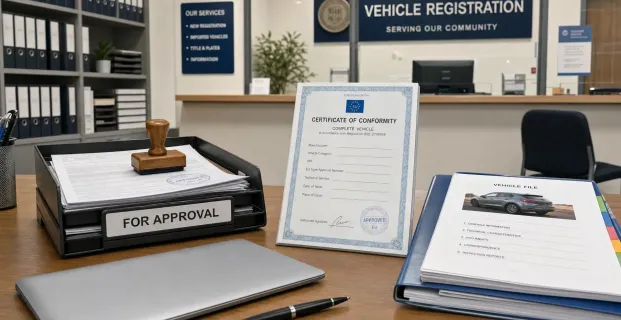
A Certificate of Conformity (COC) is the official vehicle document issued by the manufacturer or an authorized source for a vehicle that has European type approval. It links one specific VIN to a type-approved vehicle specification and provides the technical data needed by registration authorities.
A declaration of conformity is a more general statement that a product, component, or sometimes a vehicle complies with certain standards. It may be valid for its own purpose, but it often does not contain the standardized vehicle data that a registration office needs.
The confusion happens because “conformity” appears in both names, and because some countries, languages, or offices may translate terms differently. If your authority asks for a “COC,” “EC Certificate of Conformity,” or “certificate of conformity for registration,” you should generally assume they mean the vehicle COC, not a generic declaration.
For a fuller foundation on the document itself, 321COC has a detailed guide explaining what a Certificate of Conformity is and why it matters.
What a vehicle COC actually proves
A vehicle COC proves that the vehicle described on the document was manufactured in line with an approved European vehicle type. Under EU vehicle type approval rules, including Regulation (EU) 2018/858, manufacturers issue Certificates of Conformity for vehicles covered by type approval.
In practical terms, the COC connects three things:
- The exact vehicle, identified by its VIN
- The manufacturer’s approved type, variant, and version
- The technical data required for registration, taxation, and compliance checks
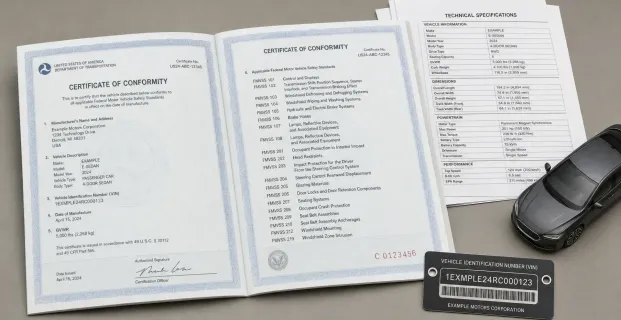
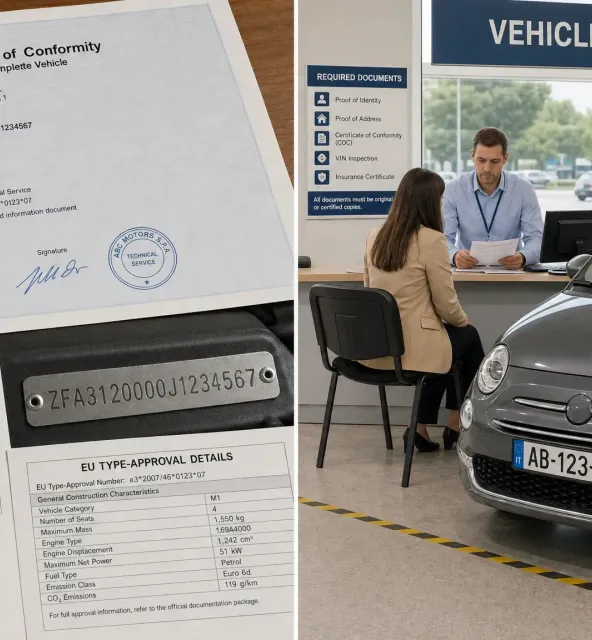
A COC commonly includes details such as the manufacturer, commercial name, VIN, EU type-approval number, body type, mass, dimensions, engine data, fuel type, emissions information, CO2 values, sound levels, axle data, tire sizes, and other technical specifications.
That technical structure is the reason registration authorities rely on it. Instead of re-checking every technical characteristic from scratch, the office can use the COC to confirm that the vehicle matches an approved European specification and can be registered according to national procedures.
What a declaration of conformity means in practice
The phrase declaration of conformity is much broader. In EU product compliance, a declaration of conformity often refers to a manufacturer’s signed statement that a product complies with applicable legislation. You will see this concept in areas such as electronics, machinery, medical devices, personal protective equipment, and many other regulated product categories.
In the vehicle world, the term can appear in several ways. It may refer to a manufacturer statement, a document for a vehicle part, a dealer confirmation, an importer’s declaration, or a translated term used informally for a COC. The problem is that the phrase alone does not tell you whether the document is suitable for registering a whole vehicle.
A declaration might say that something complies with standards, but it may not include the full type approval data required by the registration authority. It may also be issued by a party that the authority does not recognize for vehicle registration purposes.
That is why it is important to check the exact wording of the request. If the authority needs an official vehicle COC, a general declaration of conformity will often not be enough.
Key differences between a declaration of conformity and a COC
The clearest way to understand the difference is to look at the role each document plays.
A COC is vehicle-specific. It is attached to one vehicle through its VIN and describes the exact approved characteristics of that vehicle. A declaration of conformity may be product-specific, batch-specific, component-specific, or a general compliance statement, depending on the context.
A COC is designed for vehicle registration. It helps authorities register a vehicle that has EU type approval, especially when the vehicle is imported from another European country. A declaration of conformity may support compliance, but it is not necessarily designed for registration.
A COC follows a recognized vehicle type approval framework. It contains structured technical information that public authorities expect. A declaration of conformity can vary widely in format, content, and legal purpose.
A COC is issued by the manufacturer or through an official or authorized route. A declaration may be issued by a manufacturer, supplier, importer, or other party, depending on the product and regulation involved.
A COC is usually the safer document when registering an EU type-approved vehicle. If you are not sure which document your local office requires, ask whether they need the EC Certificate of Conformity for the vehicle’s VIN.
When a declaration of conformity may be enough
There are situations where a declaration of conformity is perfectly valid, but they are not always the same situations where a COC is required.
For example, a declaration of conformity may be relevant for vehicle accessories, aftermarket equipment, trailers, components, or products fitted to a vehicle. It may also be requested as part of a technical inspection file, especially if a specific component must be shown to comply with applicable standards.
A local authority may also use the words “declaration of conformity” when referring to a national form or a translated requirement. In that case, you should ask for clarification before ordering anything. The key question is whether the authority wants a generic statement of compliance or the official Certificate of Conformity linked to the VIN.
If the goal is to register a standard EU type-approved vehicle in another European country, the COC is usually the document that carries the necessary vehicle data.
Common scenarios where you need a vehicle COC
The COC is especially important when a vehicle crosses borders within Europe. If you buy a used car in one EU country and want to register it in another, the registration office may need the COC to confirm the vehicle’s technical specifications.
For example, if you import a Volkswagen, Ford, BMW, Opel, or another European-market vehicle, the authority may ask for the COC along with the vehicle’s registration certificate, invoice or sale contract, proof of identity, tax documents, and any national forms required in that country.
The same can apply when moving with your own car to another country, selling a vehicle abroad, or re-registering a vehicle after a change of country. Without the COC, the authority may need to request technical data manually, ask for additional inspections, or require a national approval procedure.
If you want to understand the online ordering process before you start, this 321COC guide to getting a COC online explains how digital requests typically work.
When a COC may not be available or may not be enough
A COC is powerful, but it is not universal. It generally applies to vehicles that were manufactured under EU type approval and match the approved specification.
If a vehicle was built for a non-European market, the manufacturer may not be able to issue an EU COC. In that case, the registration process may involve national approval, individual vehicle approval, technical inspections, or additional conformity documents.
A COC may also be insufficient if the vehicle has been substantially modified. For example, major changes to engine output, emissions equipment, suspension, body structure, seating capacity, or vehicle category can mean that the original COC no longer reflects the vehicle’s current condition. The authority may then request inspection reports or additional approvals.
Older vehicles can create another challenge. Some classic or historic vehicles may not have an EU COC because they were produced before the relevant type approval system applied to that vehicle category. Registration may then follow a different national route.
In all of these cases, the safest step is to ask the registration authority what document they will accept for your exact vehicle and situation.
How to avoid ordering the wrong document
Before paying for any document, take a few minutes to confirm what is actually required. This can save days or weeks of delay.
Start by checking the exact wording from the authority. If the request says “Certificate of Conformity,” “COC,” “EC COC,” or “European Certificate of Conformity,” you are likely dealing with the vehicle COC. If it says “declaration of conformity,” ask whether that means a generic compliance declaration or the official COC for the VIN.
Next, confirm that your vehicle is eligible. You will usually need the VIN, the brand, the model, and sometimes the first registration date or existing registration document. The VIN is especially important because a proper COC is issued for one specific vehicle.
For vehicle documents specifically, choose a service that is clear about pricing, expected delivery, and what happens if the document cannot be supplied.
What to do if you only have a declaration of conformity
If you already have a declaration of conformity and the registration office is asking for a COC, do not assume the declaration will be accepted. Submit it only if the authority confirms it meets their requirement.
If it is not accepted, you will typically have three options. You can request the original or duplicate COC through the manufacturer or an authorized route, use a specialist COC service, or follow a national approval process if no COC is available for the vehicle.
A good next step is to compare the information on your declaration with the data normally found on a COC. If it does not include the VIN, EU type-approval number, variant/version, emissions values, masses, dimensions, and other registration data, it is probably not a substitute for a COC.
Bottom line: which document should you choose?
If your goal is to register an EU type-approved vehicle, especially after importing it from another European country, the Certificate of Conformity is usually the document you need.
A declaration of conformity can be useful in other compliance contexts, but it is a broader and less specific term. It may not include the technical information or legal recognition needed for vehicle registration.
When in doubt, ask the authority one precise question: “Do you need the official EC Certificate of Conformity for this vehicle’s VIN?” If the answer is yes, order the COC rather than relying on a generic declaration.
COCs you can order on 321COC
Frequently Asked Questions
Is a declaration of conformity the same as a COC for vehicles? No. A COC is a specific vehicle Certificate of Conformity linked to a VIN and EU type approval. A declaration of conformity is a broader compliance statement and may not be accepted for vehicle registration.
Can I register an imported car with only a declaration of conformity? Sometimes, but often not. For a standard EU type-approved vehicle, authorities commonly request the COC because it contains the technical data needed for registration. Always confirm with your local registration office.
Who issues a vehicle COC? A vehicle COC is issued by the manufacturer or through an official or authorized route. It should correspond to the exact VIN of the vehicle.
Why do registration authorities ask for a COC? Authorities use the COC to verify that the vehicle matches an EU type-approved specification. It provides standardized technical data such as emissions, dimensions, masses, engine information, and type approval details.
What if my vehicle was imported from outside the EU? An EU COC may not be available if the vehicle was not built under EU type approval. You may need national approval, individual vehicle approval, technical inspections, or other documents required by the country of registration.
Can I order a COC online? Yes, many vehicle owners order a COC online using the VIN and vehicle details. Make sure the provider is transparent about pricing, delivery, and eligibility before ordering.