Certificate of Conformity Format Explained
JUMP AHEAD IN THIS ARTICLE
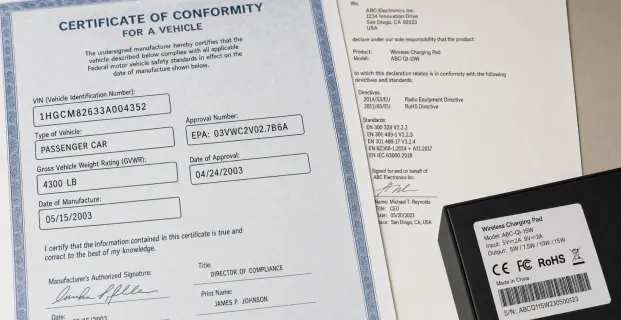
A Certificate of Conformity is often described as a simple proof document, but its format is anything but casual. For vehicle registration in Europe, the certificate must present a precise set of technical and administrative data so that authorities can confirm the vehicle matches an approved EU type.
If you are importing, registering, re-registering, or selling a vehicle across borders, understanding the Certificate of Conformity format helps you spot missing information, avoid delays at the registration office, and know when you need an official duplicate rather than a scan or unofficial template.
What the Certificate of Conformity format is designed to prove
In the vehicle context, a Certificate of Conformity, commonly called a COC, is a manufacturer-issued document confirming that a specific vehicle conforms to an EU-approved type. It connects one unique vehicle, identified by its VIN, to the technical approval data used by registration authorities.
If you need a broader introduction before focusing on the document layout, this guide explains what a COC is and when it is required. In this article, we will focus on the format itself: what appears on the document, how the fields are organized, and what details matter most when you submit it.
The format is based on the EU vehicle type-approval framework, including Regulation (EU) 2018/858 and its implementing rules. In practice, this means the exact design can vary by manufacturer, brand, language, vehicle category, and model year, but the core information follows a standardized logic.
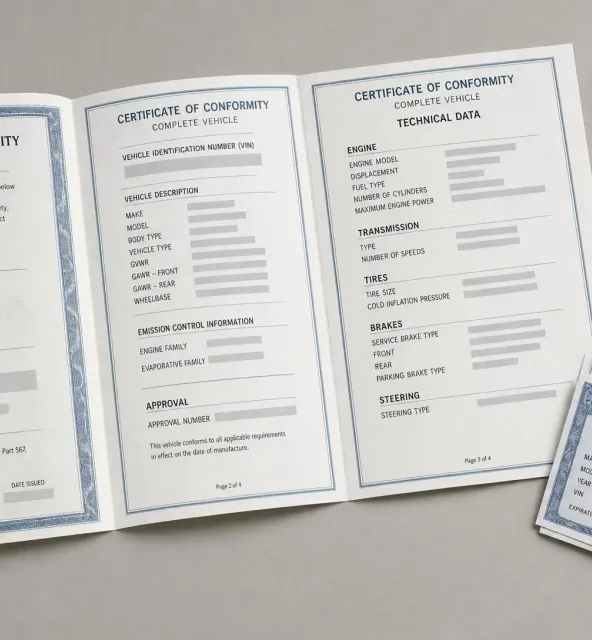
A valid vehicle COC is not just a letter with a logo. It is a structured technical certificate that allows a registration authority to verify identity, category, emissions, dimensions, masses, engine or powertrain data, and other values needed to issue or update registration documents.
Why COCs do not all look identical
Many drivers expect every COC to use the same visual template. In reality, an official COC from BMW, Toyota, Ford, Smart, Volvo, or another manufacturer may look different in layout, typography, page count, or language. That does not automatically mean one is wrong.
The most important point is that the document contains the required official data and has been issued through an authorized channel. Older vehicles may have COCs referencing older approval frameworks, while newer vehicles may reference the newer EU approval regulation. Some certificates are one or two pages, while others include several pages because the vehicle has more technical configurations or because the manufacturer includes additional explanatory fields.
The format may also differ depending on whether the vehicle is:
- A passenger car, usually category M1
- A light commercial vehicle, often category N1
- A completed, incomplete, or multi-stage vehicle
- A hybrid, electric, petrol, diesel, or alternative-fuel vehicle
- A vehicle approved under an older EU framework
So, the goal is not to find one universal visual design. The goal is to check whether the certificate includes the right official sections and whether those sections are internally consistent.
The main sections of a Certificate of Conformity
Most vehicle COCs follow a similar information flow. The order can vary, but the document usually moves from the manufacturer declaration to the vehicle identity, then to technical data, environmental values, and final authentication details.
Manufacturer and official declaration
The first part normally identifies the manufacturer or the manufacturer's authorized representative. It may include the manufacturer name, address, brand, and a formal declaration stating that the vehicle described in the certificate conforms to the approved type.
This section is important because a COC is not self-certified by the owner, dealer, or importer. It must come from the appropriate official source. If a document lacks manufacturer identification or does not clearly state that it is a Certificate of Conformity for the individual vehicle, registration authorities may refuse it.
You may also see wording such as EC Certificate of Conformity, EU Certificate of Conformity, or Certificate of Conformity for a complete vehicle. The exact wording can vary with the approval framework and vehicle type.
EU type-approval number
One of the most important fields is the type-approval number. It connects the vehicle to an EU approval granted by a national approval authority within the EU system.
A type-approval number may look similar to e1*2018/858*00001*02 or, for older approvals, may reference 2007/46/EC. The structure can indicate the approval authority country code, the regulation or directive, the base approval number, and the extension number.
For example, the first part beginning with e plus a number usually identifies the Member State authority that granted the approval. The middle section indicates the applicable regulation or directive. The final section often shows the approval and extension sequence.
Do not worry if you cannot interpret every digit. What matters for most owners is that the type-approval number is present, legible, and consistent with the vehicle category and model data.
Vehicle identification data
The vehicle identity section is where the COC becomes vehicle-specific. This is the area registration offices check closely because it links the certificate to the physical vehicle.
Typical fields include:
- Vehicle identification number, also called VIN or chassis number
- Make or manufacturer brand
- Commercial name or model name
- Vehicle category, such as M1 or N1
- Type, variant, and version
- Number of axles and wheels
- Bodywork type
- Number of seats, including the driver
The VIN is especially critical. If the VIN on the COC does not match the VIN on the vehicle and existing registration documents, the certificate will not serve its purpose. Even a small character error can cause a registration delay.
Technical characteristics
The technical section provides the data that authorities use to classify the vehicle and complete national registration records. This part often looks dense because it includes measurements and regulatory values rather than consumer-friendly descriptions.
Common technical data includes vehicle length, width, height, wheelbase, axle spacing, mass in running order, maximum technically permissible laden mass, axle load limits, towing weights, engine displacement, maximum power, fuel type, transmission, and tire and wheel combinations.
For electric and hybrid vehicles, the format may include additional fields for electric motor power, battery-related data, energy consumption, electric range, or combined powertrain information, depending on the vehicle and approval date.
Environmental and emissions information
For modern registration, emissions data can be one of the most important parts of the COC. Registration taxes, environmental badges, low-emission zone access, and national vehicle records may depend on these values.
Depending on the vehicle, the certificate may include CO2 emissions, fuel consumption, Euro emission standard, pollutant values, noise levels, exhaust information, and test-cycle references. For newer vehicles, WLTP values may appear. For older vehicles, NEDC or older test references may be present.
If the vehicle is being imported into a country where tax is partly calculated from CO2 emissions, authorities often rely on the COC because it provides manufacturer-approved values rather than estimates.
Signature, issue details, and authenticity markers
An official COC usually ends with an issue date, name or function of the authorized signatory, signature, and sometimes a stamp, security paper, watermark, serial number, or other authenticity feature. The exact authenticity features vary by manufacturer and issuing process.
A duplicate COC may be marked as a duplicate, replacement, or reissue. That can still be valid if it was officially issued, but it should not look like an edited template. Registration offices generally care less about whether it is the first original or an official duplicate than whether it is authentic and acceptable under their local process.
How to read the format without getting lost in the numbers
A COC can feel overwhelming because it combines legal approval language with engineering data. The simplest way to read it is to separate the document into three questions.
First, does the document identify the exact vehicle? Check the VIN, make, model, category, type, variant, and version.
Second, does it prove the vehicle belongs to an approved EU type? Check the type-approval number and manufacturer declaration.
Third, does it provide the technical values needed for registration? Check masses, dimensions, seats, fuel or energy type, emissions, sound levels, tires, and towing data where applicable.
You do not need to understand every technical line to use a COC correctly. But you do need the fields to be complete, readable, and consistent.
What a valid COC should not look like
Because the certificate has real administrative value, unofficial copies and poor-quality documents can create problems. A registration authority may reject a document if it appears altered, incomplete, or not issued through an authorized route.
Warning signs include:
- The VIN is missing, incomplete, or different from the vehicle
- The type-approval number is absent when it should be present
- The document looks like an editable template rather than an official certificate
- Technical fields are blank without a clear reason
- The manufacturer declaration or authentication details are missing
- The document contains visible alterations, overwritten values, or inconsistent fonts
- The scan is unreadable or cuts off sections of the certificate
A PDF copy may be useful for your records, but some registration offices still require the original or an official duplicate. Always check the local authority's requirements before assuming a scan is enough.
Certificate of Conformity format vs other conformity documents
The vehicle COC format is specific to road vehicle type approval and registration. It should not be confused with general product conformity documents, customs documents, invoices, inspection reports, or transport paperwork.
This distinction matters because people often use similar terms for very different documents. A declaration of conformity, for example, is not always the same thing as a vehicle COC. If you are comparing documents, this breakdown explains why a declaration of conformity and a vehicle COC are different documents.
Paper, PDF, or online order: does the format change?
Ordering a COC online does not change the underlying official format. The essential point is that the document must be an official certificate or official duplicate containing the correct manufacturer-approved information for your VIN.
For many owners, the easiest route is ordering a COC online through a secure process rather than trying to contact multiple manufacturers or national offices directly. When you order, the VIN is the key reference used to identify the correct vehicle and certificate.
By 2026, vehicle documentation workflows are increasingly digital, but cross-border registration remains practical and authority-driven. Some offices may accept digital submissions during the process, while others may still ask to see the original official document. If your registration deadline is close, confirm the accepted document format before you book an appointment.
What to check before submitting a COC for registration
Before you submit the certificate, take a few minutes to review the format and contents. This can prevent avoidable delays.
Check the following items:
- The VIN matches the vehicle and any existing registration papers
- The make, model, variant, and version match the vehicle you are registering
- The EU type-approval number is present and readable
- The vehicle category is suitable for the intended registration
- The emissions and CO2 values are visible, especially if local tax depends on them
- The certificate includes manufacturer declaration and authentication details
- All pages are present and in the correct order
- There are no alterations, missing corners, or unreadable sections
If any key field is missing, do not try to modify the document yourself. Contact the issuing service or manufacturer channel and request clarification or an official correction if needed.
Frequently Asked Questions
Is there one official Certificate of Conformity format for all cars? No. The data structure is standardized by EU vehicle approval rules, but the visual layout can vary by manufacturer, vehicle category, model year, and language.
What is the most important field on a COC? The VIN is the most important vehicle-specific field because it links the certificate to one exact vehicle. The type-approval number is also essential because it links the vehicle to its approved EU type.
Can I use a scanned COC for registration? It depends on the country and registration office. A scan may help during preparation, but many authorities may request the original or an official duplicate.
Why does my COC have so many technical numbers? Registration authorities use those numbers to classify the vehicle and record official data such as dimensions, weight, emissions, fuel type, seating capacity, and approved tire sizes.
Is a Certificate of Conformity the same as a registration certificate? No. The COC proves conformity with an approved vehicle type. The registration certificate proves the vehicle is registered with a national authority.
Need the right COC format for your vehicle?
If you are registering or importing a vehicle in Europe, the safest approach is to use an official Certificate of Conformity with the correct VIN, approval data, and technical format required by authorities.
321COC helps vehicle owners order official EU-compliant Certificates of Conformity online for many car brands, with transparent pricing, secure checkout, fast delivery, and money-back protection. Before your next registration appointment, make sure the document you submit is complete, official, and formatted for the job it needs to do.