COC Certificate Meaning and When You Need One
JUMP AHEAD IN THIS ARTICLE
If you are importing, exporting, or registering a vehicle in Europe, the phrase COC certificate often appears at the worst possible moment: right before a registration appointment, sale, or move abroad. The good news is that the COC certificate meaning is straightforward once you separate it from other vehicle documents.
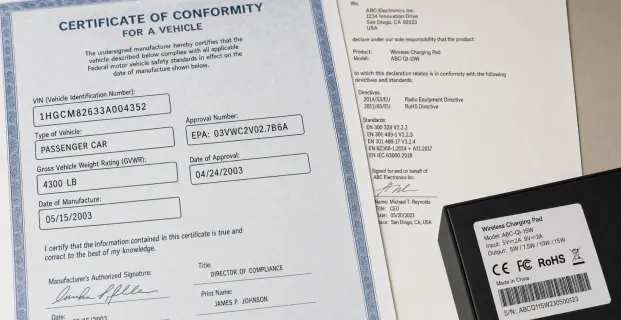
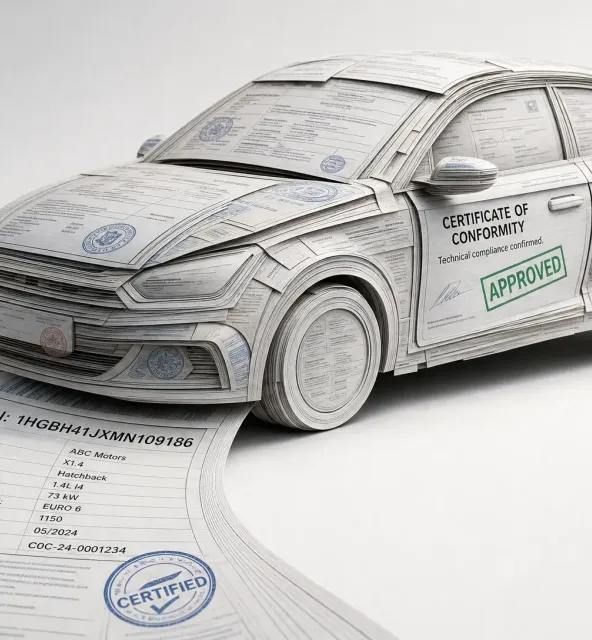
COC stands for Certificate of Conformity. For cars and many other road vehicles, it is the manufacturer’s document confirming that a specific vehicle was built in conformity with an approved type and meets the technical standards required for registration within the European Union.
In practical terms, it is a technical identity document for your vehicle. It helps a registration authority understand exactly what the car is, how it was approved, and whether it can be registered without repeating every technical check from scratch.
COC certificate meaning in plain English
A COC certificate is an official document linked to a vehicle’s VIN, also called the chassis number. It confirms that the vehicle corresponds to an EU type approval. EU type approval is the system used to verify that a vehicle model meets applicable safety, environmental, and construction requirements before it is placed on the market.
The legal basis for vehicle type approval and market surveillance in the EU is now mainly set out under Regulation (EU) 2018/858, which describes how vehicles, systems, components, and technical units are approved and monitored.
For a car owner, the important part is simple: the COC tells the authorities that your vehicle is not just a random imported car. It is a vehicle that matches a recognized technical approval, with data that can be entered into the national registration system.
That is why a COC is especially useful when a vehicle crosses borders. A car first registered in Germany, France, Belgium, Spain, Italy, the Netherlands, or another European country may need to be registered again in a different country. The COC helps translate the vehicle’s technical identity into a format the new authority can use.
It is also worth noting that COC certificate is a common search phrase, but it is technically repetitive. COC already means Certificate of Conformity, so COC certificate means Certificate of Conformity certificate. Still, the phrase is widely used by car owners, dealers, importers, and registration services.
What information does a COC include?
A Certificate of Conformity is not a sales invoice, insurance document, or proof of ownership. It is a technical document. The exact layout can vary by manufacturer and vehicle category, but it usually includes the data a registration office needs to identify and classify the vehicle.
Typical information on a COC includes:
- Vehicle identification number, make, commercial name, type, variant, and version
- EU type approval number and the approval category of the vehicle
- Engine details, fuel type, power output, emissions standard, and CO2 information
- Dimensions, weights, axle loads, seating capacity, and towing capacity where applicable
- Tire and wheel specifications, noise data, and other technical registration details
This level of detail is why a COC can solve problems that a normal registration certificate cannot. A foreign registration card may show some useful information, but it often does not contain all the technical fields required by another country’s registration database.
When do you need a COC certificate?
You usually need a COC when a registration authority must verify the technical conformity of a vehicle that was originally registered or sold in another European market. The exact rules differ by country, but the use cases are very common across Europe.
Importing a used vehicle from another European country
This is the most common reason people search for the COC certificate meaning. If you buy a used car in one European country and want to register it in another, the local registration office may request the COC to confirm the vehicle’s technical specifications.
For example, you might buy a car in Germany and register it in France, bring a vehicle from Belgium to Spain, or import a used car from the Netherlands to Italy. In each case, the authorities need to make sure the vehicle can be entered into their national registration system correctly.
The EU provides general guidance on registering a car in another EU country, but national requirements still vary. That is why it is always smart to check the exact document list before booking your registration appointment.
Moving to another country with your own car
You may also need a COC if you relocate within Europe and take your vehicle with you. Even if the car is already registered in your name, the destination country may treat the process as a new national registration. The COC helps confirm the vehicle’s technical details without relying only on the registration certificate from your previous country.
This often matters for tax classification, emissions categories, environmental stickers, road charges, and administrative fields such as engine power or CO2 value. A missing or incomplete technical field can delay registration even when ownership is clear.
Registering a new imported vehicle
If a new vehicle is purchased in one country and registered in another, the COC may be required as part of the first registration process. New vehicles are often supplied with a COC when sold, but documents can be lost, withheld, or not transferred correctly during cross-border sales.
If you are buying a new or nearly new vehicle abroad, ask for the COC before completing the purchase. It can save time and reduce the risk of discovering a registration issue later.
Selling a vehicle internationally
A COC can make a vehicle easier to sell across borders. Buyers, dealers, and import specialists may ask for it because it reduces uncertainty. If the future buyer knows the vehicle has a valid Certificate of Conformity, they can better estimate registration costs, timing, and administrative risk.
This is especially relevant for higher-value used vehicles, company cars being resold in another market, or cars advertised to buyers in multiple countries.
Correcting or completing technical registration data
Sometimes a COC is requested even when the vehicle is already registered, especially if the authority needs missing technical data. For example, the registration record may lack CO2 values, tire sizes, variant information, or precise type approval data.
In that case, the COC acts as a reference document from the manufacturer’s approval data. It does not change the vehicle, but it can help the authority complete the record accurately.
When a COC might not be enough
A COC is powerful, but it is not a universal solution for every registration problem. It only works when the vehicle has the relevant type approval and the document matches the vehicle’s VIN.
A COC may not be available or may not be sufficient if the vehicle is an older classic car, a heavily modified vehicle, a non-European market model, or a vehicle without EU type approval. In those situations, the registration authority may require national approval, individual vehicle approval, inspection reports, customs documents, or other technical evidence.
A COC also does not replace roadworthiness inspections. If your destination country requires a technical inspection, emissions test, or safety check, the COC will not exempt you unless local rules specifically say so.

COC vs other vehicle documents
One reason the COC certificate meaning can be confusing is that it is often mentioned alongside other documents. Each document has a different purpose.
A registration certificate proves that a vehicle is or was registered in a particular country. It may identify the owner or keeper depending on national rules, and it shows the license plate or registration number. A COC, by contrast, is not proof of current registration or ownership. It proves conformity with a vehicle type approval.
A purchase invoice or sales contract proves the commercial transaction. It may be needed to show ownership transfer, VAT details, or purchase value, but it does not prove technical conformity.
A roadworthiness certificate shows that the vehicle passed an inspection at a specific time. It does not prove that the vehicle was originally built to an EU-approved type.
A declaration of conformity can also cause confusion because the wording sounds similar. In vehicle registration, however, it is not always the same as a manufacturer’s COC. If you are unsure which document an authority is asking for, this guide to the difference between a COC and a declaration of conformity explains the distinction in more detail.
How to get a COC certificate
If the original COC is missing, you can usually request a replacement through the vehicle manufacturer, an authorized route, or a specialist online provider. The process normally requires accurate vehicle information, especially the VIN.
Before ordering, check the VIN carefully against the vehicle and existing registration documents. A single incorrect character can lead to delays or the wrong search result. You should also confirm the make, model, first registration date, and country where the car was previously registered if you have that information.
Delivery times and costs can vary because each manufacturer has its own procedures, document availability, and processing times. If budget is a concern, it helps to understand why COC prices vary by brand before you order.
The safest approach is to order only from a provider that clearly explains the process, the price, the expected delivery method, and what happens if the document cannot be issued. Avoid vague offers that do not clarify whether the document is an official Certificate of Conformity or merely an unofficial technical sheet.
Questions to ask before ordering
Before you pay for a COC, take a few minutes to confirm what you actually need. Registration requirements are local, and asking the right questions can prevent delays.
Useful questions include:
- Does the registration authority specifically ask for a Certificate of Conformity?
- Is the vehicle an EU type-approved model, or was it originally built for a non-EU market?
- Is the VIN readable and identical across the vehicle, registration certificate, and sales documents?
- Has the vehicle been modified in a way that could affect conformity, such as engine changes, body conversions, or major technical alterations?
- Do you need the original document, a duplicate from the manufacturer, or will the authority accept another technical document?
If the vehicle is standard, EU type-approved, and simply moving from one European country to another, a COC is often the cleanest solution. If the vehicle is unusual, modified, or imported from outside Europe, contact the registration authority first.
Common mistakes that delay registration
Many registration delays are avoidable. The most common mistake is assuming that the foreign registration certificate contains enough information. Sometimes it does, but many authorities still request the COC because it provides standardized manufacturer data.
Another mistake is waiting until the day of the appointment to check the document list. If the COC is missing, you may need to reschedule and wait for the replacement document to arrive.
Drivers also sometimes confuse a COC with a roadworthiness test. These documents answer different questions. The COC says the vehicle conforms to an approved type. A roadworthiness certificate says the vehicle passed an inspection at a certain time.
Finally, be careful with unofficial summaries or translated technical sheets. They may be useful for understanding the car, but they may not be accepted as a COC by the registration authority.
Frequently Asked Questions
What does COC certificate mean? COC stands for Certificate of Conformity. For vehicles, it is the manufacturer’s document confirming that a specific vehicle matches an approved type and contains the technical data needed for registration.
Is a COC certificate mandatory for every car registration? No. It depends on the country, the vehicle, and the registration situation. It is most often required when importing or re-registering a vehicle from another European country.
Can I register an imported car without a COC? Sometimes, but it may be harder or slower. The authority may accept other technical documents or require an inspection or individual approval. If a COC is available, it is often the simplest document to provide.
Is the COC the same as the registration certificate? No. The registration certificate proves a vehicle’s registration status in a country. The COC proves technical conformity with the approved vehicle type and lists detailed manufacturer data.
Who issues a COC certificate? A COC is issued by the vehicle manufacturer or through an authorized route connected to the manufacturer’s approval data. Specialist providers can help you request the official document online.
Does a COC expire? A COC generally does not expire in the same way as an inspection certificate because it relates to the vehicle’s original conformity. However, authorities may still require current inspections, tax documents, or other recent paperwork.
Need an official COC for your vehicle?
Understanding the COC certificate meaning is the first step. The next step is getting the right document for your VIN, brand, and registration situation.
With 321COC, you can order an official EU-recognised Certificate of Conformity online through a secure process, with transparent pricing, fast delivery, and money-back protection. If your registration office has asked for a COC, start by checking your vehicle details and ordering the document before your appointment.