European Certificate of Conformity for Imported Cars
JUMP AHEAD IN THIS ARTICLE
Importing a car can be a smart way to access a wider choice of models, better equipment, or a more attractive price. The paperwork, however, is where many buyers get stuck. One document often makes the difference between a smooth registration and weeks of back-and-forth with the local authority: the European Certificate of Conformity.
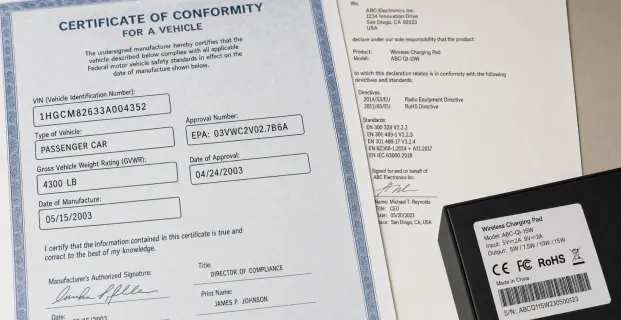
For imported cars, the European Certificate of Conformity, often called a COC, helps prove that a vehicle matches an EU-approved type and meets the technical standards required for registration in many European countries. It does not replace every document you need, but it can simplify one of the most important parts of the process: proving what the vehicle is, how it was approved, and which technical data the registration office should use.
Below, you will find a practical guide to what the COC does, when imported cars usually need it, what information it contains, and how to prepare your registration file with fewer surprises.
What a European Certificate of Conformity proves
A European Certificate of Conformity is an official document issued for a vehicle that has been manufactured according to an EU type approval. In practical terms, it connects one specific vehicle, identified by its VIN, to a recognized technical approval.
The European Union has harmonized many vehicle approval rules so that a vehicle approved under the EU framework can circulate and be registered across member states, subject to national registration formalities. The current type-approval framework is set out in Regulation (EU) 2018/858, which covers approval and market surveillance for motor vehicles and their systems, components, and separate technical units.
For a registration office, the COC is useful because it provides verified technical data without requiring the authority to reconstruct the vehicle's specifications from scratch. For the owner, it can reduce uncertainty around emissions, CO2, weight, engine power, noise levels, fuel type, dimensions, and other details that may affect registration, taxation, or inspection.
If you want a broader introduction to the document itself, 321COC also explains what a Certificate of Conformity is in a dedicated car owner's guide.
Why imported cars often need a COC
When a car moves from one country to another, the new registration authority needs to confirm that the vehicle can be registered locally. Even if the car was already registered in another European country, the new authority may not have direct access to all the technical data it requires.
The COC helps bridge that gap. It gives the authority a standardized set of information based on the vehicle's original approval, not just the seller's description or a sales invoice.
This matters most when a car is imported as a used vehicle from another European market. For example, a buyer in France may purchase a car from Germany, a buyer in Spain may import from Belgium, or a buyer in Italy may bring in a vehicle from the Netherlands. In each case, the car already exists and may have valid foreign registration papers, but the destination country still needs enough technical information to create a new national registration record.
A COC can also help prevent mistakes. A missing or incorrect emissions figure, a mismatched variant code, or an unclear type approval number can delay the process. In some countries, these data points may influence road tax, environmental classification, or whether an additional technical inspection is required.
When you are most likely to need a European COC
Whether you need a European Certificate of Conformity depends on the vehicle, the destination country, and the registration authority's rules. Still, imported car owners are most likely to need one in these situations:
- You are registering a vehicle imported from another European country.
- The local authority asks for proof of EU type approval.
- The vehicle's foreign registration document does not contain all required technical fields.
- The car is relatively recent and was originally built for the European market.
- CO2, emissions, engine, weight, or variant data must be verified for registration or tax calculation.
- The registration office requests the COC specifically before accepting your file.
A COC is not always the only possible proof. Some authorities may accept a national type approval certificate, a manufacturer's attestation, or data already available in their systems. However, for many imported cars, the COC remains the cleanest and most widely understood document.
If your main question is whether the document is mandatory in your situation, see this guide on whether you need a COC to register an imported car.
What information appears on a COC
A European Certificate of Conformity is not a simple ownership certificate. It is a technical conformity document, and the information on it must match the vehicle exactly.
Typical details include the vehicle identification number, manufacturer, commercial name, type, variant, version, EU type approval number, mass, dimensions, axle data, engine capacity, fuel type, power output, emissions standard, CO2 value, sound level, tyre information, and seating capacity.
These details matter because registration systems are data-driven. If the VIN is wrong, the document cannot reliably identify your car. If the type, variant, or version does not match the vehicle, the authority may ask for clarification. If emissions or CO2 data are missing, tax or environmental classification may be delayed.
The COC should describe the vehicle as it was approved and manufactured. If the car has been heavily modified, converted, rebuilt, or altered from its approved configuration, the registration authority may require an inspection or individual approval procedure instead of relying only on the COC.
What a COC does not replace
A common mistake is assuming that the European Certificate of Conformity is the entire import registration file. It is not. It proves conformity with an approved vehicle type, but it does not prove ownership, tax payment, insurance, customs clearance, or roadworthiness by itself.
Depending on your destination country and the car's origin, you may still need:
- The original foreign registration certificate.
- A purchase invoice or sales contract.
- Proof of identity and address.
- Customs clearance documents if the vehicle comes from outside the EU customs territory.
- VAT or tax documents where applicable.
- Valid insurance before registration.
- A roadworthiness inspection or local technical control.
- Translated or certified documents if required by the authority.
This is why it is best to treat the COC as one critical part of a larger file, not as a standalone pass. For a broader overview of the steps involved, you can use 321COC's complete guide to registering an imported vehicle in Europe.

How to get a European Certificate of Conformity for an imported car
The best time to think about the COC is before you submit your registration application, and ideally before you buy the imported vehicle. If the seller already has the original COC, ask for a clear copy and verify that the VIN matches the car and the registration papers. If the COC is missing, check whether the vehicle is eligible for one.
For many vehicles built for the European market, a replacement or official COC can be ordered using the VIN and vehicle details. 321COC provides an online process for ordering official vehicle Certificates of Conformity for many car brands across Europe, with secure checkout, transparent pricing, and money-back protection.
Before ordering, prepare the basics. You will usually need the VIN, the make and model, and any supporting vehicle information available from the foreign registration certificate. Make sure the VIN is copied exactly from the vehicle or official papers, since a single incorrect character can lead to delays or an unusable document.
It is also worth checking the vehicle's market origin. A European COC generally applies to vehicles that were covered by EU type approval. If the car was built for a non-European market, such as the United States, Japan, or another market with different approval rules, it may not be eligible for a standard European COC. In that case, the registration route may involve national approval, technical inspection, or individual vehicle approval.
Country differences: Europe is harmonized, but registration is national
The phrase European Certificate of Conformity can make the process sound identical everywhere in Europe. In reality, vehicle type approval is harmonized at EU level, but vehicle registration remains a national administrative process.
That means the same imported car may face different procedures depending on where you register it. One country may ask for a COC and a standard roadworthiness inspection. Another may require additional tax clearance or a local data sheet. A third may accept some information from the foreign registration document, but still request the COC if key fields are missing.
The European Commission's vehicle type-approval information explains the role of harmonized technical approval, but buyers should still check the exact requirements of the destination country and local registration office.
In practical terms, do not wait until your appointment to discover what is missing. Contact the authority, review its online checklist, and confirm whether your imported vehicle needs a COC, a technical inspection, a tax certificate, or translated documents.
What to check before buying an imported car
If you are still in the buying stage, a few checks can save a lot of time later. Ask the seller for the VIN, the current registration certificate, the first registration date, and any available COC or manufacturer paperwork. Compare the VIN on the documents with the VIN plate and the stamped VIN on the vehicle.
You should also ask whether the car has been modified. Changes to emissions equipment, engine mapping, body type, seating configuration, or drivetrain can create complications if the vehicle no longer matches its original approval. Accessories are usually less problematic than structural or technical changes, but the registration authority has the final say.
For higher-value imports, consider checking whether the car was originally sold in the European market. A car that looks identical to a European model may still have been produced for another market with different lighting, emissions, speedometer, or safety specifications. That difference can affect whether a European COC is available.
Finally, do not rely only on a seller's statement that registration will be easy. Ask for documents before paying, and if something is missing, factor the cost, time, and uncertainty into your decision.
Common COC mistakes that delay imported car registration
Many registration delays are avoidable. The most common problems are simple, but they can still stop an application until corrected.
- Ordering a COC with an incorrect VIN.
- Assuming every imported car is eligible for a European COC.
- Submitting a COC that does not match the vehicle's current configuration.
- Forgetting that the registration office may also require tax, customs, insurance, or inspection documents.
- Waiting until the day of the registration appointment to request the COC.
- Using unclear scans or incomplete vehicle papers when requesting documents.
The safest approach is to build your file early. Start with the vehicle identity, confirm the approval route, request the COC if needed, then gather the national registration documents required in your country.
Frequently Asked Questions
Is a European Certificate of Conformity mandatory for every imported car? Not always. Many imported cars need a COC for registration, especially vehicles with EU type approval moving between European countries, but requirements vary by country and vehicle. Some authorities may accept other proof, while non-European market vehicles may need a different approval route.
Can I register an imported car without a COC? Sometimes, yes. It depends on the destination country and whether the authority can verify the vehicle's technical data through other documents or databases. However, if the authority requests a COC, your application may not proceed until you provide one or an accepted alternative.
Does a COC prove that I own the imported car? No. A COC proves technical conformity, not ownership. You still need a purchase invoice, sales contract, foreign registration papers, and any other documents required by the local registration authority.
Can I get a COC for a car imported from outside Europe? Not always. A European COC is generally linked to EU type approval. If the vehicle was built for a non-European market, it may not have a European COC and may require national or individual approval before registration.
How early should I order the COC? Order it as soon as you know the registration authority requires it, or before your appointment if you are preparing an import file. Waiting until the last moment can delay registration, insurance finalization, or use of the vehicle.
Get your imported car registration file ready
If you are importing a car, the European Certificate of Conformity can be one of the most important documents in your registration file. It helps confirm the vehicle's EU-approved technical identity and gives the registration authority the data it needs to process your application.
To save time, check your VIN, gather your vehicle papers, and confirm whether your car is eligible for a COC before you submit your registration request. If your brand is supported, you can order your official Certificate of Conformity online with 321COC through a secure process with transparent pricing, fast delivery, and money-back protection.