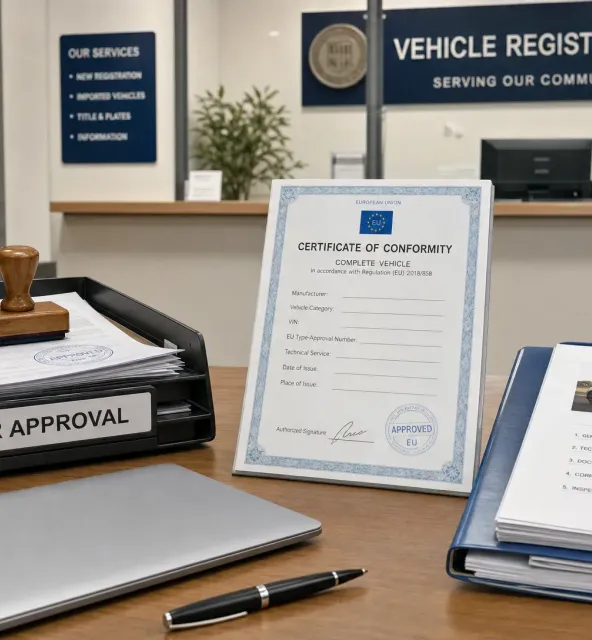
COC Certificate of Compliance: What It Means for EU Registration
JUMP AHEAD IN THIS ARTICLE
If you are registering a vehicle in an EU country, one document can make the process much smoother: the COC. In everyday searches, many drivers call it a COC certificate of compliance, because it proves the vehicle complies with European technical and environmental requirements. The official EU term is Certificate of Conformity — the practical purpose is the same: it gives registration authorities the standardized technical data they need.
This matters most when a car is imported, re-registered after a move, or missing key technical details in the national system. Without the COC, the authority may ask for extra inspections, national approval paperwork, or manufacturer confirmations.
What a COC certificate of compliance proves
A COC is issued for a vehicle produced under an EU type-approval (framework set by Regulation (EU) 2018/858). It confirms that the specific vehicle, identified by its VIN, conforms to the approved specification — which is why it's so useful to registration offices: it is tied to one exact vehicle, not a general brand statement.
It typically carries the VIN, make/variant/version, EU type-approval number, engine and emissions data, CO2 values, dimensions, weights, seating, and tire specifications. For a full walk-through of the document itself, see our guide to what a COC certificate is and when you need one.
If you want a broader introduction to the document itself, 321COC has a separate guide explaining what a COC certificate is and when you need one. This article focuses specifically on the EU registration angle.
When EU registration requires it
Registration is handled nationally, but approval rules are harmonized — so the COC is the standard way to fill the technical gap when a vehicle crosses borders. You are most likely to need one when:
- importing a used car from another EU country,
- registering a new vehicle bought abroad,
- re-registering after moving residence,
- or recovering technical data for a vehicle with incomplete documents.
The COC also feeds tax and classification: in many countries CO2 values, fuel type and Euro standard determine what you pay. For import-specific scenarios, see: Do I need a COC to register an imported car?
One honest limit: a COC is not always enough. Vehicles built for non-EU markets, heavily modified, or without EU type-approval may need individual approval or a technical inspection instead. The EU's Your Europe vehicle registration guidance is a good starting point for country specifics.
For import-specific scenarios, you may also find this guide helpful: Do I need a COC to register an imported car?
How to use the COC for registration
- Confirm the VIN — it must match exactly across the vehicle, foreign registration document, purchase paperwork and COC request. One wrong character causes delays.
- Check eligibility — non-EU-market or modified vehicles may need a different document; ask the authority first.
- Order from a trusted source — official certificates, transparent pricing, secure checkout.
- Review on arrival — VIN, make, engine, fuel type and approval data must correspond to the vehicle.
- Submit with your file — alongside identity, ownership, tax, insurance and roadworthiness documents required locally, and keep a copy for later resale or export.
Most delays even with a COC come from mismatched data — a VIN discrepancy, a modified vehicle whose original specification no longer matches, or a photocopy where the original is required. Compare all documents side by side before your appointment.
COC vs other vehicle documents
The COC proves technical conformity; the registration certificate proves a vehicle is registered in a country; a roadworthiness test checks its condition at a point in time; customs paperwork covers non-EU entry. Registration offices usually need several of these — the COC handles the technical part. For the closely related "declaration of conformity" confusion, see our dedicated comparison of declaration of conformity vs COC.
Frequently asked questions
Is a COC certificate of compliance the same as a Certificate of Conformity? Yes — the official EU term is Certificate of Conformity; "certificate of compliance" is the everyday name for the same document.
Do I always need a COC to register a car in the EU? Not always — it's commonly required for imported or re-registered vehicles, but rules vary by country, age and origin.
Can I register a non-EU vehicle with a COC? Many non-EU-market vehicles have no standard EU COC and need individual approval or inspection instead.
Can I order a COC before buying the vehicle? You need the exact VIN — if you're still deciding, confirm COC eligibility before committing, especially for imported or modified vehicles.
Get your COC ready before registration
Getting the document early is one of the smartest steps in any import or re-registration. 321COC helps drivers order official EU-recognized Certificates of Conformity online for many brands — transparent pricing, secure checkout, fast delivery, Trustpilot reviews and money-back protection. Have your VIN ready (from the vehicle itself, not just the sales listing) and start your request at 321COC. To start your request, visit 321COC and prepare your VIN before ordering.