COC Document Meaning for Car Registration Explained
JUMP AHEAD IN THIS ARTICLE
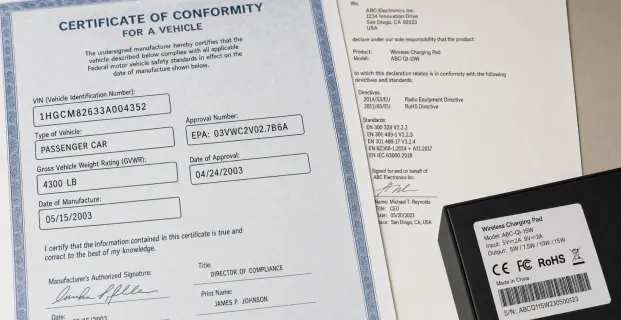
If you are registering an imported vehicle, moving a car to another European country, or replacing missing vehicle paperwork, you may be asked for a COC document. The COC document meaning is simple: it is a Certificate of Conformity, an official document confirming that a specific vehicle complies with the approved technical and environmental standards for its vehicle type.
For car registration, that short explanation matters a lot. A registration office does not only need to know that your car exists. It needs reliable technical data, such as the VIN, type approval number, emissions values, fuel type, weights, dimensions, and other details that determine whether the vehicle can be registered and how taxes or fees may be calculated.
What does COC document mean?
COC stands for Certificate of Conformity. In the European vehicle registration context, it is normally issued by the vehicle manufacturer or an authorized source and identifies one specific vehicle, usually by its VIN.
The document confirms that the car, as produced, matches an EU-approved vehicle type. In other words, it tells the registration authority that the vehicle was built according to the technical specifications approved for that model, version, and variant.
Some people also use phrases like “certificate of compliance” or “COC papers.” In everyday conversation, they often mean the same paperwork. However, for EU vehicle registration, the standard term is Certificate of Conformity.
The legal background comes from EU vehicle type approval rules. Regulation (EU) 2018/858 sets out the framework for approval and market surveillance of motor vehicles and requires manufacturers to provide conformity documentation for approved vehicles. National registration offices then use this information when processing registrations.
Why the COC matters for car registration
A COC helps bridge the gap between the country where a vehicle was originally sold and the country where you want to register it. Without it, the registration authority may not have enough standardized technical data to complete the file quickly.
This is especially common when buying a used car abroad. The vehicle may already have a foreign registration certificate, but that certificate does not always contain every technical field required by the new country. A COC fills many of those gaps because it follows the manufacturer’s approved technical data.
For example, an authority may use the COC to verify the vehicle category, emissions standard, CO2 value, engine output, mass, tire specifications, and noise levels. These details can affect registration eligibility, environmental classification, road tax, inspection requirements, and administrative processing.
A COC does not replace all local registration documents. You may still need proof of ownership, an invoice, an existing registration certificate, insurance, tax forms, inspection documents, or identity documents, depending on the country. But it often plays a central role in proving the vehicle’s technical conformity.
When are you likely to need a COC document?
You are most likely to be asked for a COC when a car crosses a registration border or when the registration office cannot verify the vehicle’s technical data from existing documents.
Common situations include:
- Importing a used car from another EU country.
- Registering a new vehicle purchased abroad.
- Re-registering a vehicle after moving to another country.
- Replacing a missing original Certificate of Conformity.
- Completing a registration file when the foreign registration certificate lacks required technical details.
The exact requirement depends on the country, the age of the vehicle, the original market, and the type approval status. The EU’s Your Europe vehicle registration guidance is a useful starting point, but your local registration office has the final say on the documents it requires.
If you are unsure whether your case requires a COC, ask the registration authority before your appointment. This can help you avoid delays, especially for older vehicles, modified vehicles, or cars originally built for a non-EU market.
What information is included in a COC?
A valid COC contains standardized technical and identification information. The exact layout can vary by manufacturer and vehicle type, but the purpose is consistent: to identify the vehicle and provide the approved data needed for registration.
| COC information | Why it matters for registration |
|---|---|
| VIN (Vehicle Identification Number) | Links the document to one specific car. |
| Manufacturer and commercial name | Confirms the brand, model, and production identity. |
| EU type approval number | Shows that the vehicle type was approved under EU rules. |
| Vehicle category | Helps classify the vehicle for registration and regulatory purposes. |
| Engine and fuel data | Supports technical classification and tax calculations. |
| CO2 and emissions information | May affect environmental class, road tax, or access rules. |
| Masses and dimensions | Confirms weight limits, vehicle size, and technical compatibility. |
| Tires, noise, and other specifications | Provides data used for safety, inspection, and registration records. |
If you want to recognize the main sections before submitting your paperwork, this guide to what a valid COC looks like explains the usual format in more detail.

COC vs registration certificate vs declaration of conformity
A COC is often confused with other vehicle documents. The difference is important because registration offices may ask for one document and reject another if it does not serve the same purpose.
| Document | Main purpose | Usually issued by |
|---|---|---|
| Certificate of Conformity (COC) | Confirms a specific vehicle conforms to an approved vehicle type. | Manufacturer or authorized official source. |
| Registration certificate | Shows that the vehicle is registered in a specific country. | National registration authority. |
| Declaration of conformity | A broader statement that a product meets certain requirements, not always the same as a vehicle COC. | Manufacturer, importer, or responsible party depending on the product. |
For vehicles, the COC is usually the document tied most directly to EU type approval and registration data. A registration certificate proves the car was registered somewhere, but it may not include all technical fields needed in another country. A declaration of conformity may sound similar, but it is not automatically a substitute for a vehicle COC. For a deeper comparison, see the explanation of the difference between a COC and a declaration of conformity.
How registration offices use the COC
When you submit a COC for car registration, the authority normally uses it to verify and transfer data into the national registration system. The process varies by country, but the logic is usually similar.
- Identity check: The office compares the VIN on the COC with the VIN on the vehicle and other documents.
- Type approval verification: The EU type approval number helps confirm that the vehicle belongs to an approved type.
- Technical data entry: The authority uses the COC to record values such as emissions, power, weight, dimensions, and fuel type.
- Tax and fee assessment: Some countries calculate registration tax, road tax, or environmental fees using data from the COC.
- Registration decision: If the file is complete and the vehicle meets local requirements, the office can issue or update registration documents.
This is why accuracy matters. A wrong VIN, missing page, poor-quality copy, or document that does not match the vehicle can delay the application.
Does every car need a COC?
No. Not every registration case requires a COC, and not every vehicle can receive one.
A COC is most relevant for vehicles that have EU whole vehicle type approval and were produced for the European market. For many modern passenger cars, this is straightforward. For other vehicles, the situation can be more complex.
A COC may not be available or may not be enough if the vehicle was originally built for a non-EU market, is very old, has no EU type approval, has been significantly modified, or falls into a special category. In those cases, the registration authority may ask for a national approval, individual vehicle approval, technical inspection report, or other supporting documents.
This does not mean registration is impossible. It means the COC may not be the only route. Always confirm with the authority responsible for your registration before ordering documents for an unusual vehicle.
What if your COC is missing or incorrect?
If the original COC is missing, you usually need to request a replacement from an official or authorized source. A photocopy, unofficial template, or self-made document should not be treated as a valid substitute. Registration authorities generally need documentation they can trust.
If the COC contains an error, do not edit it yourself. The correction should come from the issuer or an authorized channel. Even a small discrepancy, especially in the VIN, variant, version, fuel type, or emissions value, can cause the registration office to pause the application.
Before ordering or submitting a COC, check the vehicle’s VIN carefully. It should match the VIN on the chassis, existing registration certificate, purchase invoice, and any other official paperwork. One wrong character can create avoidable delays.
Practical checklist before your registration appointment
A COC is only one part of the registration file, so prepare your documents as a set. Requirements vary, but this checklist can help you avoid the most common issues.
- Confirm whether your registration office requires an original COC, a certified copy, or another accepted format.
- Check that the VIN on the COC matches the vehicle and all supporting documents.
- Make sure the COC is complete and readable, with no missing pages.
- Bring the foreign registration certificate if the car was previously registered.
- Ask in advance about local taxes, inspections, translations, and proof of ownership requirements.
If you are dealing with a deadline, order the COC as early as possible. Registration appointments, shipping times, and authority processing times can all add days or weeks to the process.
Frequently Asked Questions
Is a COC document the same as a Certificate of Conformity? Yes. In vehicle registration, a COC document means Certificate of Conformity. It confirms that a specific vehicle matches the approved technical specifications for its type.
Can I register a car without a COC? Sometimes, but it depends on the country and the vehicle. Some authorities accept other technical documents or require an individual approval process. For many imported EU vehicles, a COC is the simplest way to provide the required technical data.
Who issues a COC for a car? A COC is issued by the manufacturer or an authorized official source. It should be linked to the vehicle’s VIN and reflect the manufacturer’s approved technical data.
Does a COC expire? A COC generally describes the vehicle as it was built and does not work like a temporary permit. However, modifications, missing data, or local administrative rules can affect how it is used for registration.
Is a COC needed for used cars? It often is, especially when importing a used car from one European country to another. Even if the car has a foreign registration certificate, the new registration office may still ask for the COC to confirm technical and emissions data.
Can I use a scanned copy of a COC? That depends on the registration authority. Some offices may request the original document or a specific official format. Always ask before submitting a copy if you are unsure.
Need a COC for car registration?
Understanding the COC document meaning is the first step. The next step is making sure you have the correct official document for your vehicle and registration country.
If your registration office has asked for a Certificate of Conformity, you can order an official Certificate of Conformity online through 321COC. The service supports many car brands across Europe and offers a secure online process, transparent pricing, EU-compliant documents, and money-back protection.
Before you start, have your VIN and vehicle details ready. The more accurately you provide the vehicle information, the easier it is to request the correct COC and keep your registration process moving.