Proof of Conformity for Cars: What Counts?
JUMP AHEAD IN THIS ARTICLE
When a registration office, customs agent, inspection center, or buyer asks for proof that a car is compliant, the answer is not always as simple as showing any document with the vehicle’s details. In Europe, the document that carries the most weight is usually the Certificate of Conformity, commonly called the COC. But depending on the vehicle’s origin, age, approval status, and destination country, other documents may also be accepted, or may only support your application.
This guide explains what usually counts as proof of conformity for cars, what does not, and how to avoid delays when registering, importing, exporting, or selling a vehicle.
What “proof of conformity” means for a car
Proof of conformity is evidence that a specific vehicle matches an approved technical standard. For cars in the European Union, this usually means the vehicle conforms to an EU type approval, covering areas such as safety, emissions, noise, lighting, dimensions, masses, engine data, and other regulated specifications.
The key point is that conformity is not just about whether the car is roadworthy today. A vehicle can pass a technical inspection and still lack the paperwork needed to prove it was manufactured according to an approved type. Likewise, a car can have all its registration papers and still need a separate conformity document when moved to another country.
The strongest document is typically the Certificate of Conformity. Under the EU vehicle type-approval framework, including Regulation (EU) 2018/858, the COC is issued by the manufacturer and certifies that the individual vehicle conforms to the approved type.
If you are new to the topic, this broader guide on what a Certificate of Conformity is explains the purpose of the document in more detail.
The document that usually counts most: the Certificate of Conformity
For most EU-registered passenger cars, the COC is the primary proof of conformity. It links a specific vehicle, identified by its VIN, to an approved vehicle type. It is especially important when a car is being registered in a different EU or EEA country from where it was first sold.
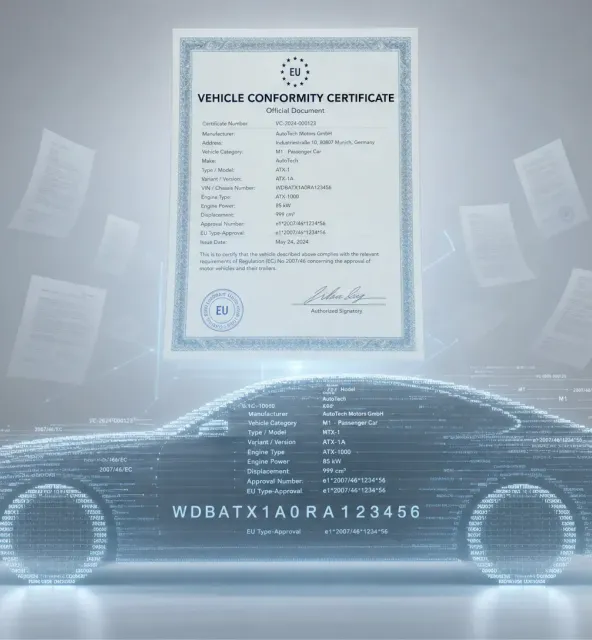
A valid COC usually includes information such as:
- Vehicle Identification Number, or VIN
- Manufacturer and commercial name
- EC type-approval number
- Vehicle category
- Engine and fuel details
- Emissions data
- CO2 values and environmental class
- Weights, dimensions, axles, and tire specifications
- Signature or issuing authority details from the manufacturer or authorized issuer
A COC is valuable because it gives registration authorities standardized technical data. Instead of manually verifying every specification, the authority can rely on the certificate to complete national registration, taxation, and database entries.
An official duplicate COC can also count if the original was lost, provided it is issued through a recognized channel and matches the vehicle’s VIN and type approval. A photocopy or scan may help start a file, but many authorities still ask for the original document or an officially accepted duplicate.
Why authorities ask for conformity proof
Conformity proof matters because registration is not only an ownership process. It is also a technical and regulatory process. Before a car is allowed onto public roads under a national registration number, the authority may need to confirm that the vehicle meets applicable standards.
This is particularly common in cross-border cases. For example, if you buy a used car in Germany and want to register it in France, Spain, Italy, Belgium, the Netherlands, or another European country, the destination authority may need technical data that is not fully shown on the foreign registration certificate.
According to the European Union’s official guidance on registering a vehicle in another EU country, registration requirements can differ between countries. That is why one authority may accept existing registration documents, while another may request a COC or an equivalent approval document.
Documents that may count, depending on the case
Not every car has an EU COC, and not every registration situation is identical. These documents may count as proof of conformity in certain circumstances, but their acceptance depends on the vehicle and the country handling the registration.
Individual vehicle approval certificate
If a car does not have EU type approval, the registration authority may require an individual approval, sometimes called single vehicle approval, national approval, or an equivalent inspection-based approval. This is common for certain imports from outside the EU, heavily modified vehicles, kit cars, or vehicles that were never sold under an EU type approval.
This document does not work the same way as a manufacturer COC. Instead of proving that the car belongs to an already approved EU type, it proves that the individual vehicle has been examined and approved under a national procedure.
National type approval document
Some older vehicles, special vehicles, or vehicles registered under national systems may rely on national type approval documents rather than an EU COC. These may be accepted locally or under specific administrative routes, but they are not always accepted in the same way across borders.
If the car was first registered before modern EU type-approval rules applied, the authority may ask for additional technical data, a manufacturer attestation, or a national inspection.
Manufacturer attestation or technical certificate
In some cases, a manufacturer or authorized representative can issue a technical attestation confirming certain vehicle specifications. This may be useful when the authority needs a missing data point, such as emissions values or weights.
However, an attestation is not automatically the same as a COC. It may support a registration file, but whether it counts as full proof depends on the local authority’s rules.
Previous foreign registration certificate
A foreign registration certificate can be important evidence that the car was previously registered and used legally. It may show the VIN, registration date, fuel type, engine capacity, power, emissions class, or other technical information.
Still, it is not always complete enough to replace a COC. Many national registration certificates omit data required in another country’s system. If the destination authority needs standardized EU type-approval data, the registration certificate alone may not be sufficient.
Documents that usually do not count as conformity proof
Some documents are useful for ownership, tax, insurance, or roadworthiness, but they do not normally prove technical conformity by themselves.
A purchase invoice proves a sale. It does not prove the vehicle conforms to an approved type.
An insurance document proves coverage. It does not establish emissions, type approval, or manufacturer conformity.
A customs clearance document proves an import procedure. It does not necessarily prove the vehicle meets EU vehicle standards.
A technical inspection report proves the car passed an inspection at a point in time. It does not automatically prove that the car was manufactured according to an EU-approved type.
A service book or maintenance record can help verify history, but it is not proof of conformity.
A declaration of conformity may sound similar, but it is not always accepted as a substitute for a COC. If you have both terms in your paperwork, the difference is worth checking carefully. This article on Declaration of Conformity vs COC explains why the wording matters.

How to tell whether your document is likely to be accepted
A conformity document should identify the exact car, not just the model range. The VIN is the most important link between the certificate and the vehicle. If the VIN does not match perfectly, registration authorities will usually reject the document or ask for clarification.
The document should also show official technical data. For an EU COC, look for the EC type-approval number, vehicle category, emissions information, masses, dimensions, and other structured fields. If you want to understand the typical layout, this guide to conformity certificate format shows what a COC generally looks like and which sections matter.
You should also check who issued the document. A valid COC is normally issued by the manufacturer or an authorized source. A generic translation, seller-made sheet, dealer specification printout, or unofficial template is unlikely to be accepted as full proof of conformity.
Language can matter too. Some authorities accept COCs in another EU language because the format is standardized, while others may request a translation or additional national form. Always check with the registration office before assuming a document will be accepted exactly as provided.
What if the car is imported from outside the EU?
For non-EU imports, the situation can be more complex. A car from the United States, Japan, Switzerland, the United Kingdom, or another non-EU market may not have an EU COC. Even if the model looks identical to an EU version, the vehicle may have different lighting, emissions equipment, safety markings, speedometer units, or technical approval status.
In these cases, proof of conformity may require one or more of the following:
- An EU COC, if the vehicle was built under an EU type approval and is eligible for one
- A national individual approval or inspection certificate
- Technical data from the manufacturer
- Evidence of modifications needed to meet local registration requirements
- Customs and tax documents, alongside the technical approval documents
The most important step is to confirm whether the exact VIN is covered by an EU type approval. If it is not, a COC may not be available, and the registration path will usually depend on national approval procedures.
What if the car has been modified?
Modifications can affect conformity. Minor changes may not create a problem, but major changes can make the vehicle differ from the approved type described on the COC.
Examples include engine swaps, suspension conversions, changes to seating capacity, emissions-related modifications, significant body changes, or non-approved lighting. If the vehicle no longer matches the data on the COC, the authority may require an inspection, updated approval, or engineering report.
This is one reason buyers should be cautious with imported used cars that have been tuned, converted, or rebuilt. A COC proves the vehicle’s original conformity, but it may not cover later changes.
What to do if you do not have proof of conformity
Start by checking the documents that came with the car. Look for the original COC, previous registration certificate, purchase invoice, technical inspection report, and any manufacturer documents. Keep originals safe, because some authorities do not accept copies.
Next, check whether the vehicle is eligible for an official COC. You will usually need the VIN, make, model, and sometimes the first registration date. The VIN is essential because the certificate must match the individual vehicle.
If a COC is not available, contact the registration authority in the country where you plan to register the car. Ask which alternative documents are accepted for your vehicle category and origin. This can save time and prevent you from ordering the wrong document.
If the authority specifically asks for a COC, it is usually best to obtain an official document rather than trying to replace it with partial paperwork. Using a trusted provider can simplify the process, especially if you are handling a cross-border registration and need transparent pricing, secure checkout, and support for multiple brands.
Common scenarios and what usually counts
For a used car bought in another EU country, the COC is often the clearest proof. The foreign registration certificate may help, but the destination country may still ask for a COC to complete technical fields.
For a new car sold by an official dealer in the EU, the COC is normally supplied with the vehicle documents. If it is missing, ask the seller immediately before completing registration.
For a lost COC, an official duplicate is usually the right replacement, as long as the vehicle is eligible and the duplicate comes from an accepted source.
For a car imported from outside the EU, a COC only counts if the car was built under an EU type approval. Otherwise, individual approval or a national process may be required.
For a modified car, the original COC may not be enough if the modifications affect regulated specifications. The authority may require additional approval.
Frequently Asked Questions
Is a registration certificate proof of conformity? A registration certificate can support your file, but it is not always enough. It proves the car was registered, while a COC proves the vehicle conforms to an approved type and provides standardized technical data.
Is a technical inspection report the same as proof of conformity? No. A technical inspection report shows that the car met inspection requirements at a specific time. It does not necessarily prove the vehicle was manufactured according to an EU type approval.
Can I register a car without a COC? Sometimes, yes. Some authorities accept alternative documents, especially for older vehicles or vehicles already registered in another country. However, many cross-border registrations are faster and simpler when you have an official COC.
Does every car have a Certificate of Conformity? No. Many EU type-approved vehicles have a COC, but some older vehicles, non-EU imports, special vehicles, or individually approved vehicles may not be eligible for one.
What is the best proof of conformity for a car in the EU? In most standard cases, the best proof is the official Certificate of Conformity issued for that exact vehicle. It must match the VIN and provide the technical data required for registration.
Need official proof for your vehicle registration?
If your registration office has requested a Certificate of Conformity, 321COC helps you order official EU-recognised COCs online for many car brands. The process is designed to be secure, transparent, and simple, with fast delivery and money-back protection.
You can start your request through 321COC and use your VIN to find the right conformity document for your vehicle.