Certificate of Conformity Requirements in Europe
JUMP AHEAD IN THIS ARTICLE
If you are importing a vehicle, moving to another European country, or preparing a first registration, the Certificate of Conformity can be the document that keeps the process moving. It confirms that a specific vehicle was built according to an approved European type and gives registration authorities the technical data they need to issue local documents.
The challenge is that “Certificate of Conformity requirements” can mean several things at once: whether the vehicle is eligible for a COC, what a valid certificate must contain, what supporting documents you need, and what your local registration office may ask for in addition. This guide breaks those requirements down in practical terms so you can prepare your file with fewer delays.
What a Certificate of Conformity requirement really covers
A Certificate of Conformity, often shortened to COC, is an official manufacturer document linked to vehicle type approval. For cars and many other road vehicles, the European framework is based on EU type-approval rules. Regulation (EU) 2018/858 sets out the approval and market surveillance system for motor vehicles and trailers, including the role of certificates of conformity for approved vehicles.
In plain English, the COC confirms that the vehicle identified by its VIN matches an approved European vehicle type. It is not the same as a roadworthiness inspection, insurance certificate, customs declaration, or proof of ownership. Those may all be needed in a registration file, but they serve different purposes.
If you want a broader explanation of the document itself, including when it is commonly requested, 321COC has a separate guide on what a COC certificate is and when you need one. This article focuses specifically on the requirements side: what has to be true for the COC to be accepted and what you should prepare before ordering or presenting one.
When a COC is required for registration in Europe
A Certificate of Conformity is most often requested when a vehicle is registered in a European country for the first time, especially after cross-border purchase or import. For example, if you buy a used car in Germany and want to register it in France, Spain, Belgium, the Netherlands, Italy, or another European country, the local registration authority may ask for the COC to verify technical information.
The same applies to many new vehicles that need first registration. Dealers often handle this automatically for domestic sales, but private buyers, importers, and people relocating with a vehicle may need to obtain or present the certificate themselves.
The EU’s Your Europe vehicle registration guidance explains that registration formalities vary by country, but technical documentation can be important when registering a vehicle in another EU country. A valid EC or EU Certificate of Conformity generally helps authorities confirm that the vehicle conforms to an approved type, which can reduce the need for additional technical checks.
In practice, a COC may be requested when:
- You register an imported used vehicle from another European country.
- You register a new vehicle for the first time.
- You need technical values such as CO2 emissions, Euro emissions class, mass, dimensions, tire sizes, or engine data.
- You are exporting a vehicle and want to make registration easier for the buyer.
- A registration office cannot retrieve the vehicle’s technical data from its own system.
A COC is not always mandatory in every case. Some countries have national databases, alternative approval documents, or special procedures. However, when the vehicle is eligible for a COC, having the official document is often the clearest way to prove conformity.
What you need before requesting a COC
The exact requirements for ordering a Certificate of Conformity depend on the brand, vehicle, market, and issuing channel. Still, most requests start with the same core information: the vehicle identification number, the vehicle’s current registration details, and enough applicant information to process the order securely.
Before you apply, prepare the following where available:
- The full 17-character VIN, copied directly from the vehicle or registration certificate.
- A scan or photo of the current registration certificate, sometimes both parts if your country uses Part I and Part II.
- Proof of ownership, such as an invoice, purchase contract, or title document, if requested.
- The make, model, year, body type, and fuel type.
- A photo of the manufacturer plate or VIN plate, if requested for verification.
- Your name, company details if applicable, delivery address, and contact information.
- Any information about modifications, conversions, or missing documents.
Small errors can cause big delays. A single incorrect VIN character can lead to the wrong vehicle record or make the order impossible to validate. If the foreign registration certificate has abbreviations, make sure the details match the physical vehicle and the purchase documents.
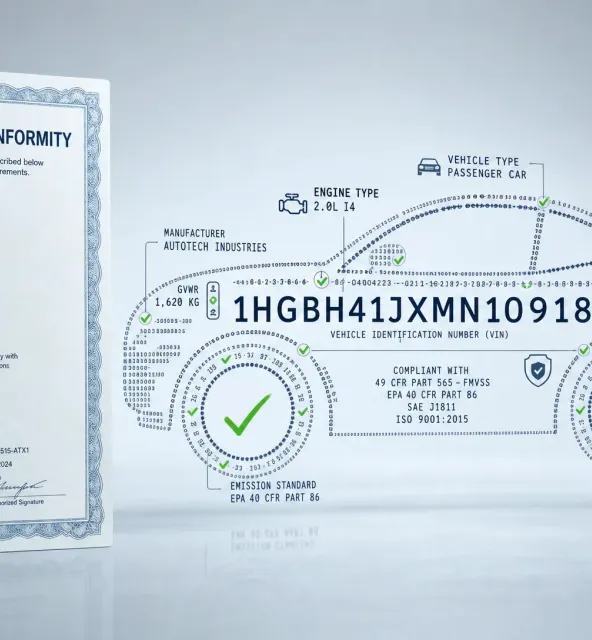
It also helps to understand what the finished document looks like before you submit it to an authority. You can review this Certificate of Conformity example to see the type of data commonly included, such as approval numbers, vehicle category, masses, emissions information, and tire specifications.
Valid COC requirements European authorities usually check
A registration authority is not only checking that you have a document called a COC. It is checking whether that document is valid for the specific vehicle and useful for the registration procedure. These are the requirements that matter most.
The COC must come from the manufacturer or an authorized source
A valid COC is issued by the manufacturer or through an authorized channel. Generic templates, unofficial “data sheets,” or edited copies are not the same thing. Authorities may reject documents that do not come from an official source or that appear altered.
This is especially important when ordering online. A legitimate COC service should identify the vehicle by VIN and provide an official document where the vehicle is eligible. If a website promises a certificate for every possible vehicle without checking eligibility, be cautious.
The vehicle must have European type approval
A standard European COC is generally available for vehicles produced with EC or EU type approval. This is common for vehicles originally intended for the European market, but it is not guaranteed for every vehicle in the world.
Vehicles imported from the United States, Canada, Japan, the Gulf region, or other non-European markets may not have a European type approval record, even if the model name looks familiar. In those cases, a standard COC may not be available. The vehicle may instead need a national individual approval, technical inspection, manufacturer statement, or other compliance procedure depending on the country.
Older vehicles can also be affected. If a car was built before the relevant EU type-approval system applied to that category, a modern COC may not exist. Some classic vehicles follow separate national historic vehicle rules instead.
The VIN must match exactly
The VIN on the COC must match the VIN on the vehicle, the foreign registration certificate, and the purchase documents. Registration offices use the VIN to connect the certificate to one specific vehicle, not just to a make and model.
Check for common mistakes before submitting documents: the letter O confused with zero, the letter I confused with one, missing characters, or VINs copied from an advertisement instead of an official document. If the VIN plate is damaged or the registration certificate contains a historical error, resolve that issue before relying on the COC.
The vehicle should still match its approved configuration
A COC describes the vehicle as it was type-approved and manufactured. Major modifications can create problems if the vehicle no longer matches the approved type. Examples include engine swaps, substantial weight changes, body conversions, fuel system changes, suspension modifications that alter technical parameters, or commercial-to-camper conversions.
Minor accessories may not matter, but anything that changes emissions, masses, seating, dimensions, braking, or vehicle category can trigger additional inspection. In that situation, the COC may still be useful, but it may not be enough by itself.
The document must be complete and readable
Registration authorities need the technical data, not just the first page or a partial scan. A complete COC typically includes detailed information about the vehicle type, variant, version, engine, emissions, masses, dimensions, axles, tires, and approval references. If a page is missing, the office may not be able to enter the required values.
Many authorities prefer the original paper document or a verified official electronic process where accepted. A photocopy may be useful for your records, but it may not be sufficient for registration. Always check your local office’s current rule before your appointment.
Country differences to expect
The COC is designed to support European recognition of vehicle type approval, but registration remains a national process. That means each country can ask for additional documents unrelated to the COC itself.
Common additional requirements include proof of identity or residence, proof of ownership, valid insurance, a roadworthiness inspection for used vehicles, VAT or customs documents, and payment of registration taxes or environmental charges. Some countries calculate taxes using CO2 emissions or power output, which is why the technical values on the COC matter.
There can also be language and format differences. The COC itself is usually based on standardized European fields, but supporting documents such as invoices, foreign registration certificates, or customs papers may need translation depending on the authority.
If you are moving from one EU country to another, start by checking the national registration office’s latest checklist. If you are importing from outside the EU, check both customs and vehicle approval rules before buying the vehicle, not after it arrives.
Cases where a standard COC may not be enough
A COC is powerful, but it is not a universal solution for every registration problem. You may need extra steps if the vehicle falls outside normal European type-approval conditions.
Non-EU market vehicles are the most common example. A BMW, Mercedes-Benz, Audi, Volkswagen, Toyota, or Ford sold in the United States may differ from the European version in lighting, emissions systems, safety equipment, labels, speedometer units, or software. Even if the model exists in Europe, that specific VIN may not have an EU type approval.
Converted vehicles can also require more than a COC. Vans converted into campers, vehicles with added seats, taxis converted back to private use, or cars adapted for special purposes may need inspection reports or national approval after conversion.
Damaged and rebuilt vehicles can raise additional questions. If a car has been declared salvage in another country or repaired after major structural damage, the registration authority may request roadworthiness evidence, repair documentation, or a special inspection.
Finally, motorcycles, trailers, agricultural vehicles, and commercial vehicles may follow category-specific rules. A COC may still exist, but the issuing framework and registration requirements can differ from a standard passenger car.
Common mistakes that delay COC acceptance
Many registration delays come from avoidable preparation issues. The most frequent mistake is waiting until the registration appointment to discover the COC is missing. If you are importing a vehicle, check the requirement before transport, tax payment, or inspection scheduling.
Another mistake is confusing the COC with a roadworthiness certificate. A roadworthiness test confirms the current condition of the vehicle. A COC confirms the approved technical specification at production. Many used vehicles need both.
Applicants also run into trouble by submitting an unofficial copy, a dealer printout, or a technical specification sheet instead of an official COC. Those documents may contain useful data, but they may not satisfy a registration authority.
Finally, some buyers assume that all European-looking vehicles are automatically eligible. Eligibility depends on the specific VIN and type approval, not just the badge on the bonnet or the country where the vehicle is currently located.
Quick checklist before you register
Before going to the registration office, use this checklist to reduce the risk of rejection:
- Confirm whether your destination country requires a COC for your vehicle type and situation.
- Check that the vehicle has European type approval or is otherwise eligible for an official COC.
- Verify the VIN on the vehicle, registration certificate, purchase document, and COC.
- Make sure the COC is complete, readable, and issued through an official source.
- Prepare supporting documents such as proof of ownership, insurance, identity, tax, customs, and inspection papers.
- Disclose major modifications or conversions before assuming the COC will be enough.
- Keep copies for your records, but bring the original or accepted official format if required.
A well-prepared file saves time because it gives the registration officer what they need in one place: proof of ownership, proof of identity, roadworthiness where required, and the technical conformity data from the COC.
Frequently Asked Questions
Is a Certificate of Conformity mandatory in every European country? Not in every case. It is commonly required for imported vehicles and first registrations, but national rules vary. Some authorities can use national databases or alternative approval documents, while others ask for the official COC.
Can I get a COC for a vehicle imported from outside Europe? Only if that specific vehicle is covered by European type approval and the manufacturer can issue a COC for the VIN. Many non-EU market vehicles require individual approval or other national compliance procedures instead.
Does a Certificate of Conformity expire? A COC usually does not have a simple expiry date like an insurance certificate. However, it must still match the vehicle. If the vehicle has been significantly modified, the COC may not be enough for registration.
Can I use a copy of the COC for registration? Some offices may accept verified electronic records or copies in limited situations, but many require the original official document. Check the rule in the country where you are registering the vehicle.
What is the most important information needed to order a COC? The VIN is the key identifier. You should also prepare the current registration certificate, proof of ownership if requested, vehicle details, and clear contact and delivery information.
Get your Certificate of Conformity ready with 321COC
If your vehicle is eligible and you need an official COC for European registration, 321COC helps you order an EU-recognized Certificate of Conformity online through a secure process. The service supports many vehicle brands, offers transparent pricing, and provides money-back protection where applicable.
Before your registration deadline or appointment, start by checking your VIN and preparing your documents. You can begin your Certificate of Conformity order online with 321COC and make your European registration file easier to complete.